


A traveler is driving in for Saturday's game. She has a spaniel in the back seat and types "pet-friendly hotel near the stadium" into her phone. She looks at three results in the map pack and Google Hotel Finder, taps the second, and books direct. The whole thing takes four minutes.
You were not one of the three. Neither was the hotel with the better rooms two streets over. Great rooms don't rank on their own. Google ranks what it can verify, which is why local SEO for hotels starts with proof rather than pretty pictures, and why the properties winning hotel category searches tend to be the best-connected ones in town.
So what put those three hotels on her screen? Price and photos mattered, sure. But before any of that, Google had to decide those properties were trusted, relevant, genuine parts of that neighborhood. A big part of how it reaches that verdict comes from who else on the web vouches for you. That is local link building for hotels, and most independent properties are either ignoring it or doing it badly.
Here is the short version of the argument. Local links prove your hotel belongs to its market. That proof lifts you in organic results, strengthens your prominence in the map pack, and increasingly shapes which hotels AI tools recommend. In this guide we will cover how links build authority, how they move category rankings, where hotels can actually earn them, what to avoid, how to measure results, and a 90-day plan you can start on Monday.
How Google decides which hotels to show
Google's local results rest on three pillars: relevance, distance, and prominence. Relevance asks whether you match what the traveler typed. Distance asks how close you are to the searcher or the place they named. Prominence asks how well known and trusted you are.
You cannot move your building closer to the stadium. You can absolutely change how prominent and relevant Google thinks you are. Links feed prominence directly, and they nudge relevance through the context around them.
Let's be honest about the weighting, because plenty of agencies oversell this. In Whitespark's 2026 Local Search Ranking Factors survey, experts put link signals at roughly 8% of map pack influence, well behind your Google Business Profile (around 32%) and reviews (around 20%). In local organic results, the blue links under the map, links jump to around 24%. For AI search visibility the estimate is about 13%.
So links are a supporting act in the map pack and a headliner everywhere else. That matters for hotels more than most businesses. OTAs and metasearch swallow huge chunks of every hotel results page. The organic and category positions you own outright are where direct bookings come from, and that is exactly where links do their heaviest lifting.
How local links build hotel authority
Links are votes, but not all votes count the same
A backlink is another site saying "this hotel is worth knowing about." The old instinct was to collect as many as possible. That instinct is expensive and mostly wrong. One link from your city's tourism board will do more than fifty from directories nobody visits. Source beats count, every time.
Trust flows from reputable local sites
When a well-established local site links to you, some of its ranking equity flows your way. Think of it as borrowed reputation. A quick note on metrics: Domain Authority and Domain Rating are third-party estimates from Moz and Ahrefs. They are useful for comparing sites, but Google does not use them. Never pay for a link because it has a shiny DR number.
Geography tells Google where you belong
A link from the convention and visitors bureau, the local paper, or the theater down the road anchors you to a place. A link from an unrelated overseas blog tells Google almost nothing about whether you deserve to rank for "hotels in Charleston." Your hotel backlinks should look like a map of your neighborhood.
Entity association builds confidence
Google increasingly thinks in entities: real things with real relationships. When your hotel is mentioned alongside the restaurants, venues, and attractions everyone already trusts, Google grows more confident about who you are and where you operate. This works even without a clickable link. Unlinked brand mentions on credible local pages still count as evidence, which is why we track them as carefully as links.
What "category rankings" actually means for a hotel
GBP categories versus query categories
This is where a lot of hotel owners get muddled, so let's separate two things. Your Google Business Profile categories (Hotel, Boutique hotel, Resort hotel) are settings you choose. No link will ever change them.
Query categories are different. These are the ways travelers slice the market in their searches: pet-friendly, business hotel, beachfront, hotel with spa, hotel near the convention center. You don't pick these in a dropdown. You earn them, and links are one of the strongest ways to do it.
The landing page principle
Links only lift a category if they point at a page built for that category. If the wedding planner, the stadium, and the university all link to your homepage, Google gets three votes for "this hotel exists" and very little for "this hotel is the right answer for weddings, game days, and campus visits."
Homepage-only link building is the most common mistake we see in hotel local SEO. The homepage gets stronger. The category pages that should be ranking for high-intent searches stay invisible.
Context and anchor text do the talking
Google reads the words around a link, not just the link itself. Picture a wedding blog describing "the garden terrace where the couple said their vows, with string lights and views over the harbour," with a link to your events page. That paragraph tells Google exactly what the page is about. A bare "click here" in a footer tells it nothing.
You rarely control anchor text on earned links, and you shouldn't try too hard. What you can control is giving people something specific to describe.
Matching link strategies to the categories you want to win
The fix for homepage-only link building is simple: decide which category each link is meant to win before you go and get it. Here is how that maps out for a typical independent hotel.
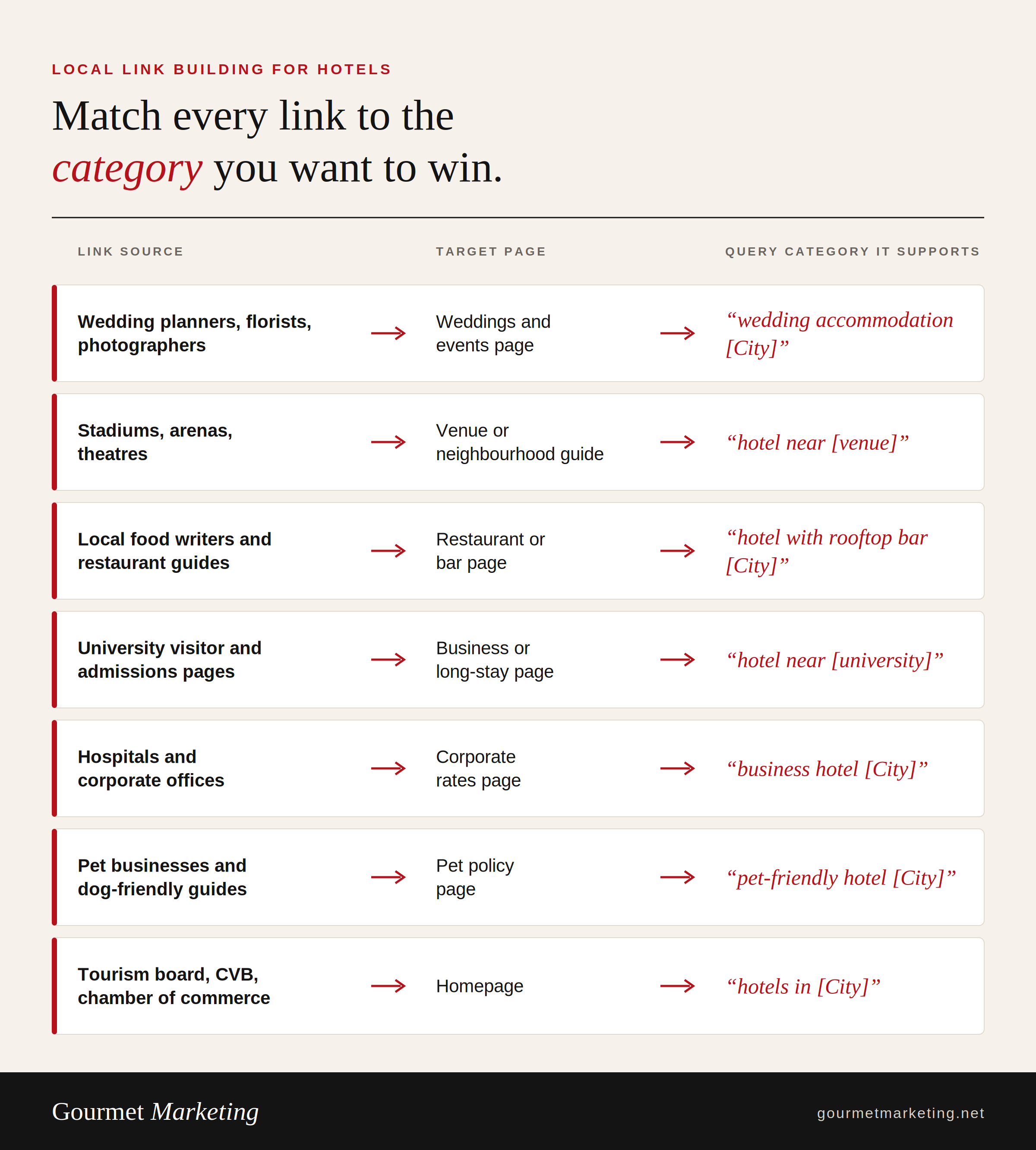
One nuance for events-heavy properties: "Wedding venue" is its own Google Business Profile category. If you want to appear for venue searches, not just accommodation searches, add it as a secondary category and back it up with a genuinely strong events page. The links then have something solid to land on.
The best local link sources for hotels
Convention and visitors bureaus and tourism boards
These are the highest-tier local links you can get. They are authoritative, unmistakably local, and visited by actual travelers. Most are tied to membership. If your annual CVB fee feels steep, remember you are paying for the listing, the referrals, and one of the strongest local signals available.
Event and concert venues
Many venues keep a "where to stay" or "preferred lodging partner" page. Offer a group rate or a modest discount code for ticket holders and ask to be listed. A single venue partnership can feed both a link and a steady trickle of game-night bookings.
Universities, hospitals, and corporate offices
Visitor accommodation pages for graduation weekends, admissions tours, visiting consultants, and patient families are everywhere. They often go unclaimed. A negotiated rate is usually the price of admission.
The wedding and events ecosystem
Planners, photographers, florists, and wedding blogs publish "real wedding" features with vendor credits. Build a simple post-event process: two weeks after each wedding, your events coordinator emails the vendors with a thank-you, a few photos, and a request to credit the venue with a link. It is boring. It works.
Local press
Journalists need stories, not press releases. Give them a renovation reveal, a new chef with an interesting background, a sustainability program with real numbers, the history of your building, or community work you are proud of. A single feature in the city paper can outperform a year of directory submissions.
Sponsorships and community involvement
Charity runs, food festivals, youth sports teams, and arts nights all publish sponsor lists. Choose the ones your guests and neighbors care about, so the link is a bonus and not the whole point.
Chambers of commerce and business associations
Not glamorous, but local, credible, and usually easy. Join, complete the listing properly, and point it to the most relevant page.
Linkable assets on your own site
Sometimes the best way to get links is to build something worth linking to. A genuinely useful neighborhood guide, a local events calendar, or a transportation and parking guide for the venue next door will attract links from bloggers, planners, and even competitors' guests.
Unlinked mention reclamation
This is the quickest win in the whole list. Search for your hotel's name, find pages that mention you without linking, and send a short, friendly note asking for the link. Conversion rates are high because the writer already likes you.
"Best hotels in [City]" roundups
Travel writers and local bloggers publish these constantly. Getting included earns a relevant link, and it also feeds AI visibility, because AI tools draw heavily on exactly these lists. If you want help building this into a wider plan, our hotel local SEO services treat local link building as part of the same program as your Google Business Profile and reviews.
Local links and AI search
Ask ChatGPT, Gemini, or Google's AI Overviews for "a quiet boutique hotel in Lisbon with a good restaurant" and you will get three or four names. Those names are not random. AI tools assemble answers from sources they consider credible: tourism sites, respected publications, review platforms, and those ever-present "best hotels in" roundups.
That makes credible mentions even more valuable here than in classic rankings. A traditional search result page shows ten links. An AI answer might show three hotels, and if you are not one of them, you don't exist in that conversation.
The practical takeaway is reassuring. You don't need a separate AI strategy for links. The same local link work that lifts your organic rankings is what gets you cited in AI answers. Do it well once and it pays twice. We go deeper on how Google's own travel surfaces use these signals in our guide to local SEO and Google Hotel Finder.
What to avoid
Every few weeks, a hotel GM forwards us an email promising "50 high-DA hotel backlinks for $299." Please don't. Here is what to steer clear of.
- Paid links and link packages. Buying links that pass ranking value breaks Google's spam policies. At best they are ignored. At worst they drag the whole site down.
- Mass directory submissions. A few quality, relevant directories are fine. Hundreds of irrelevant ones are noise, and sometimes worse.
- Sitewide footer links. A "hotel partner" link in the footer of every page of a web design firm's site looks manipulative and passes little value.
- Relying on OTA listings for visibility. Your Booking.com and Expedia pages build their brand and their rankings, not yours.
- Pointing every link at the homepage. As covered above, this strengthens the front door and leaves your category pages unranked.
Links work best on top of strong fundamentals
Links amplify what is already there. They cannot rescue a half-finished profile or a page of three-star reviews from 2022. Get the order right:
- Complete your Google Business Profile. Categories, attributes, photos, accurate amenities, and correct hours for the restaurant and spa.
- Build a steady review flow. Recency matters as much as volume. Twenty fresh reviews a month beat 2,000 that went quiet a year ago.
- Create dedicated category pages. Weddings, pet-friendly stays, business travel, the venue guide. Each one needs real substance, not 150 words and a stock photo.
- Then build links to those pages.
- Finish with internal linking so authority flows from your strongest pages to the ones that need it.
If steps one to three aren't solid, step four is money spent pushing on a door that's locked. Our local SEO for hotels guide walks through those fundamentals in detail.
How to measure the impact
If you can't show the owner what changed, the budget won't survive the next quarterly review. Track four things.
Referring domains, segmented. Total backlinks is a vanity number. Count unique referring domains and split them into local and relevant versus everything else. The local, relevant column is the one that should grow.
Grid-based rank tracking. Tools like Local Falcon and BrightLocal check your map pack position across a grid of points around the hotel. You will often find you rank third near the property and vanish six blocks away, right where the convention center is. That is where you aim the next round of links.
Search Console data for category pages. Filter impressions and clicks to the pages receiving links and the queries they target. If the weddings page is earning links, "wedding accommodation [City]" impressions should climb.
Realistic timelines. Organic movement usually shows within one to three months of a quality link landing. Map pack effects are slower and smaller, which matches the weighting we covered earlier. Set those expectations with ownership up front and nobody panics in week three.
A 90-day local link plan
This is the plan we would hand a GM who has a marketing manager, a sales team, and no spare hours. It is deliberately realistic.
Month 1: Foundations
- Audit your existing backlinks and find every unlinked mention of the hotel.
- Join the CVB and chamber of commerce if you haven't already, and point those listings at the right pages.
- Build or improve two or three category landing pages for the segments you most want to win.
Month 2: Outreach
- Contact the three nearest venues, the main university, and your top five wedding vendors with a specific offer and a specific page.
- Pitch one local press story. Pick your strongest angle, not your newest amenity.
- Send reclamation emails for every unlinked mention found in month one.
Month 3: Assets and review
- Publish one genuinely useful linkable asset, such as a game-day guide or a neighborhood food map.
- Secure one community sponsorship that fits your guests.
- Pitch two or three writers who publish "best hotels in [City]" roundups.
- Review referring domains, grid rankings, and Search Console data, then plan the next quarter.
A sensible first-quarter target is somewhere around 8 to 15 new local, relevant referring domains. That doesn't sound like much. For an independent hotel, it can be the difference between page two and the top three.
Proof of belonging
Go back to that traveler with the spaniel. The hotels she saw had earned their place long before she picked up her phone. The stadium listed them. A local blog had reviewed their dog-friendly courtyard. The tourism board had them on its accommodation page. Google simply connected the dots.
Local links are proof that your hotel belongs to its market. They lift your organic and category rankings, support your map pack prominence, and shape which hotels AI tools put in front of travelers. Most importantly, they win the searches that turn into direct bookings instead of OTA commissions.
Start with one category you want to own this quarter, build the page, and earn three links pointing at it. Then do it again.
If you would rather have a team run this for you, Gourmet Marketing's hotel SEO agency builds local link programs for boutique and luxury hotels as part of a wider direct booking strategy. See how we combined citation and link building to take a new Midtown property to the top of Google Hotel Finder in our Forth Atlanta case study, then book a local SEO audit and we will show you exactly which categories you are leaving on the table.
Frequently asked questions
Do backlinks help hotels rank in Google Maps?
Yes, but modestly. Experts in Whitespark's 2026 survey estimate links at around 8% of map pack influence, compared with roughly 24% for local organic results. Your Google Business Profile and reviews matter more for Maps, while links matter more for the organic results below it.
How many local links does a hotel need?
There is no magic number. What counts is how your relevant local referring domains compare with the hotels outranking you. For many independent properties, 10 to 30 strong local links pointed at the right pages is enough to move category rankings.
Are directory listings worth it for hotels?
A handful are: your CVB, chamber of commerce, and well-known travel and local business directories. They keep your details consistent and add local relevance. Mass submissions to hundreds of irrelevant directories are not worth the time.
How long does local link building take to work?
Organic rankings usually respond within one to three months of a quality link landing. Map pack changes are slower and smaller. Treat it as a quarterly program, not a one-off project.
Can I buy local links for my hotel?
You shouldn't. Paying for links that pass ranking value breaks Google's spam policies and puts the whole site at risk. Sponsorships and memberships are fine, because the link is a by-product of a genuine relationship.