


Here's the number most 2027 hotel budgets haven't caught up with yet. CoStar and Tourism Economics expect U.S. average daily rate (ADR) to rise just 1.6% in 2027, while STR's president warns that operating expenses will keep climbing faster than inflation. Rate increases alone won't close that gap. So the travel industry trends 2027 will bring more than usual for independent hotels: next year's winners will be the properties that catch new kinds of demand, book it direct and earn more from every stay.
We read the major 2027 trend reports from Skyscanner, Expedia, Priceline, Hilton and Phocuswright, then checked them against the demand forecast. Below are the top travel trends independent hotels should know, each with a verdict (act now, watch or skip), plus a 90-day plan and a one-night package you can copy.
What are the biggest travel trends for 2027?
The biggest travel trends for 2027 are AI-assisted trip planning, shorter and more frequent trips, travel built around events and hobbies, demand for hotels with real character, practical wellness and sharper value hunting. For independent hotels, the common thread is specificity. The properties that describe and package exactly what they offer will win the booking.
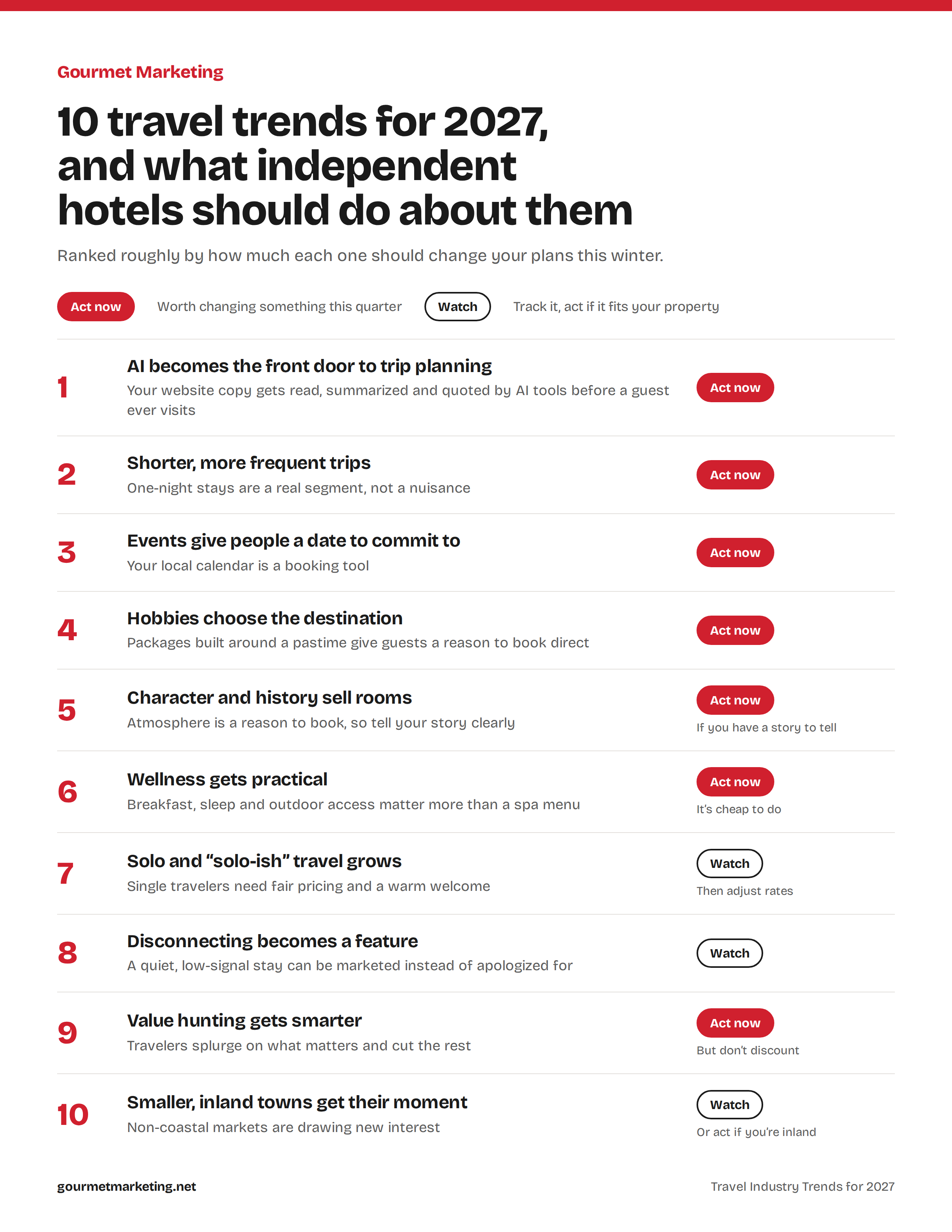
Here's the whole list at a glance, with our verdict for a typical independent property.
 What is the travel industry outlook for hotels in 2027?
The 2027 outlook for U.S. hotels is steady but slower. CoStar and Tourism Economics forecast 63.4% occupancy, ADR up 1.6% and RevPAR up 2.1%, below the long-term average of about 3%. Expenses are expected to keep rising faster than inflation, so protecting profit, not chasing top-line growth, is the real job next year.
A quick definition, since these numbers drive everything below. RevPAR (revenue per available room) is your room revenue divided by every room you had available, sold or not. ADR (average daily rate) is your room revenue divided by rooms sold.
The forecast comes from the 2026 to 2027 U.S. hotel outlook that CoStar and Tourism Economics released in August 2026. It's actually an upgrade. In January, the same group projected only 1.4% RevPAR growth for 2027, according to Lodging Magazine. Stronger leisure and business travel in 2026 pulled the outlook up.
Four details from that forecast matter for independent operators:
- Costs are the squeeze. STR president Amanda Hite called rising expenses "worrisome" and said they'll outpace inflation in both 2026 and 2027.
- Summer comparisons will look ugly in some markets. Hite expects mid-year weakness in 2027 because of tough comparisons with 2026, when the World Cup and America 250 celebrations lifted demand.
- Groups are a tailwind. Tourism Economics' Aran Ryan pointed to recovering group travel and business investment spreading beyond AI projects.
- International travel is a mixed bag. Ryan expects modest improvement in international visitors, with ongoing U.S. and Canada trade tensions as the headwind to watch.
If you're near a 2026 host city, put this in front of your owners now. A June that's down 8% against a World Cup June isn't a marketing failure. It's math. Set 2027 targets against 2025 as well as 2026 so nobody panics over a comparison effect.
10 Travel Industry Trends for 2027 and What Each Means for Your Hotel
These are the travel industry trends 2027 will be built on, ranked roughly by how much they should change what you do this winter. Each one ends with the move we'd make first.
1. AI becomes the front door to trip planning
AI is now a normal part of how people plan trips. According to Phocuswright's The AI Surge report, 56% of U.S. travelers used AI for at least one trip in the past 12 months, up from 43% in late 2025.
Here's the part most hotel articles skip. In the same study, only 8% of travelers said an AI answer alone was enough, and 51% clicked through to the source websites.
Hilton's 2027 research adds that 70% of travelers trust hotel staff as a planning resource. So AI decides whether you make the shortlist, and your website and your people close the sale.
AI tools quote facts, not adjectives. Compare these two room descriptions:
- Before: "Experience timeless elegance in our beautifully appointed rooms."
- After: "All 18 rooms have king beds and blackout curtains, and six have clawfoot tubs. We're a four-minute walk from Main Street, parking is free, and dogs under 40 pounds stay for $35 a night."
The second version (an example, not a real property) answers five questions a traveler might ask ChatGPT or Google. The first answers none. Start by rewriting your five most visited pages with plain facts, then add a real FAQ page. Our guide to Google's AI travel planner explains how those itineraries get built, and our hotel SEO services cover the technical side.
2. Shorter, more frequent trips
Hotels.com calls it Trip Snacking. In Expedia Group's Unpack '27 report, 79% of travelers said they plan to book a one-night stay in the coming year, rising to 83% of Gen Z and Millennials. Hotels.com searches for one-night stays with Thursday to Sunday check-ins are up nearly 10% year over year.
Hilton found the same pattern. About 21% of travelers are adding more short "micro trips" to their plans, and 29% say shorter trips let them travel more spontaneously.
Now look at your booking engine. Many independents run a two-night minimum length of stay (MLOS) on weekends. That's a rule that blocks any booking shorter than a set number of nights. It protects Saturdays in peak season. Outside peak, it often turns away a Saturday-only guest while Friday sits empty anyway.
The fix is simple. Keep weekend minimums for your true compression dates, but release one-night stays when Friday is still open about two weeks out. Price that single night a little higher, or sell it as a package so it feels like a treat rather than a leftover. We've included a copyable one-night package later in this post.
[CLIENT EXAMPLE: a property that lifted weekend minimum stays outside peak and what happened to occupancy and ADR]
3. Events give people a date to commit to
A concert, a race or a college football game turns "we should get away" into a booked trip. Hilton's 2027 report found that a fixed event motivates 61% of travelers to book and commit to travel. On Hotels.com, attending a concert, show or sporting event is the second most common reason for a one-night trip (32%), just behind celebrating a life milestone (34%).
Most small hotels treat local events as something that happens to them. Treat your event calendar as a sales tool instead.
List every festival, race, game, concert and graduation within an hour's drive for all of 2027. Build a simple landing page for the bigger ones at least 90 days out, with distance, parking and a package. Those pages can rank for searches like "[event name] hotels" that OTAs cover poorly. They also give your email list a reason to hear from you.
4. Hobbies choose the destination
Vrbo found that 68% of travelers are likely to take a hobby-focused trip in 2027, climbing to 79% of Gen Z and Millennials. The top hobbies people want to bring on vacation are puzzles and board games, photography, stargazing, crafting and antiquing. Hilton adds that Gen Z travelers are twice as likely as baby boomers to want to pick up a new hobby on a trip.
Vrbo is pitching this as a vacation rental trend, which tells you who you're competing with. A rental gives a group a big table. A hotel can give them a host.
Think about what your area is already good at. An inn near an antiques district can offer an "Antique Row Weekend" with a dealer map, a late checkout and a spot to hold purchases. A rural property with dark skies can run "Dark Sky Nights" with a loaner telescope and a stargazing guide. Packages like these aren't on Expedia, so they're a reason to book direct.
5. Character and history sell rooms
Atmosphere is a booking reason on its own. According to Expedia Group, 56% of travelers have booked a hotel for its atmosphere or aesthetic alone. Hotels.com has also seen demand for castles rise 20% year over year, and travelers drawn to moody, Gothic-style hotels often cite an interest in historic properties with a rich past (46%). Skyscanner's report points the same way, with history-inspired travel among its seven 2027 trends.
Our take: don't repaint the lobby. Tell the story you already have, like the year the building went up, what it was before it became a hotel, who stayed there and which room still has the original floors.
That story belongs on your room pages and in your photo captions, not buried on an About page nobody reads. It works for almost any of the different types of lodging, from a 1920s motor court to a Victorian B&B.
6. Wellness gets practical
The 2027 version of wellness travel is less about spa menus and more about how guests feel at 7 a.m. In Skyscanner's 2027 travel trends research, 67% of UK Millennials said they're more likely to book a hotel that offers a nutritious breakfast. Hilton found that 76% of travelers say travel helps them recharge in ways they can't at home, and 79% call the outdoors essential to relaxing.
You don't need a spa to win this guest. You need to describe what you already have with some care.
Say what's actually on the breakfast table (local eggs, Greek yogurt, a gluten-free option) instead of "complimentary breakfast." Mention the coffee that's ready at 6 a.m., and map a 3-mile running loop from the front door.
Note the blackout curtains and the quiet hours, too. These details cost almost nothing, and they show up in exactly the kind of searches AI tools answer.
7. Solo and "solo-ish" travel grows
Hilton's research found that 41% of travelers plan to take a solo trip, and 31% plan to travel solo and then meet friends or family at the destination. Hilton calls the second group "solo-ish."
Solo travelers notice when a property was set up for couples. Check whether your booking engine prices a single guest the same as two people with breakfast for two included. Look at whether your lobby or bar has a spot where one person can sit comfortably.
Remember that 70% figure from trend 1. A solo guest is the one most likely to ask the front desk where to eat or hike, so make sure your team has good answers ready. We'd call this a watch item for most properties. Check your 2026 data for single-occupancy stays, and adjust rates and messaging if the share is growing.
8. Disconnecting becomes a feature
Skyscanner calls it Signal Severance. One in four Gen Z travelers plans to completely disconnect during a 2027 trip.
If your property sits in a valley with two bars of signal, this is your chance to stop apologizing for it. A "No Signal Past the Porch" weekend, with a phone lockbox at check-in and a stack of board games, turns a weakness into a story.
Just don't overcorrect. The guest who's working remotely from your inn on a Tuesday still needs fast Wi-Fi, so keep it strong and keep it listed. This one's a watch item unless your location already fits it.
9. Value hunting gets smarter
Travelers in 2027 will still spend, but they'll choose carefully where the money goes. Priceline's 2027 Where to Next? report calls it TripMaxxing: saving on one part of a trip so you can splurge on another. On Hotels.com, 45% of one-night travelers say finding a good deal is their most important consideration.
The instinct is to drop rates. Resist it. In a year when ADR growth is forecast at 1.6%, a 15% discount takes years of rate growth off the table.
Make the splurge easy to buy instead. Offer room upgrades, late checkout and add-ons right in the booking path, priced clearly. When you do want to promote value, put it inside a package rather than cutting your public rate. That protects rate parity, which means offering the same room rate on every channel where your hotel is sold.
One more value signal to watch: Skyscanner's Currency Chasers trend shows travelers moving trips toward destinations where their money goes further. Combined with the U.S. and Canada trade tensions flagged in the CoStar forecast, border markets that depend on Canadian guests should plan for a slower 2027 from that segment.
10. Smaller, inland towns get their moment
Vrbo's Heartland Hideouts trend found that nearly 65% of travelers vacationed in a non-coastal destination in the past 12 months. Searches for Bentonville, Arkansas, rose 140% year over year, and Deadwood, South Dakota, rose 120%. Travelers cited local culture, food and art, fewer crowds and affordability.
If you run an inland property, this is good news you should say out loud. Market your town's food, art and outdoor access to drive markets within three to four hours, and give people a reason to pick you over the coast.
Coastal properties can file this under watch. Your bigger opportunity is probably trend 2 or trend 3.
Which 2027 travel trends are overhyped for independent hotels?
The most overhyped 2027 trends for independent hotels are the ones built for big brands and big destinations: location-exclusive merchandise, adults-only theme park trips, screen-inspired Set-Jetting and Gothic redesigns. They make great headlines. Unless your property already fits one, chasing it will cost more than it brings back.
These are the ones we'd skip, and why:
- Pilgra-merch (Skyscanner's name for travelers buying location-exclusive goods). It's real, but it mostly helps retailers. A branded tote at the front desk is fine. A merch strategy isn't worth your time.
- Un-Adulting. Expedia Group says 57% of travelers are likely to book a carefree, adults-only trip, but its examples are theme parks and cruises. If you're 20 minutes from one, sell it. If not, move on.
- Set-Jetting. Screen-inspired travel works when a show films in your town. You can't make that happen, so react when it does instead of planning around it.
- Gothic Getaways as a design brief. The demand behind this trend is about character and history, which we covered in trend 5. Don't spend renovation money chasing a color palette.
- Joint bachelor and bachelorette trips (Skyscanner's Sten Do Surge). This is worth a look only if you can sell a small buyout. If you can, fold it into your group sales plan.
The pattern here is worth remembering every year. A trend report from an OTA or a booking app tells you what its own customers are searching for. That's useful. It isn't a business plan for a 30-room inn.
How should an independent hotel prepare for 2027?
Start with the three trends that cost the least and pay back fastest: rewrite your website with plain facts for AI tools, loosen minimum stays outside peak dates, and build packages around local events and hobbies. Then brief your owners on the 2027 forecast so everyone judges results against the right baseline. All of it fits in 90 days.
Here's the order we'd work in, starting now:
- Weeks 1 to 2: Pull your 2026 data. Look at denied or abandoned one-night requests, single-occupancy stays and which months were inflated by one-off events.
- Weeks 1 to 2: Review every minimum stay rule in your booking engine and channel manager. Keep the ones that protect true compression nights and drop the rest.
- Weeks 2 to 4: Rewrite your five most visited pages (home, rooms, location, dining or breakfast, and policies) with specific facts. Add an FAQ page that answers the questions your front desk hears every week.
- Weeks 3 to 6: Build your 2027 event calendar and pick the four to six events worth a landing page and a package.
- Weeks 4 to 8: Create one hobby or interest package that only books direct, using something your area is already known for.
- Weeks 6 to 10: Set up tracking in GA4 (Google Analytics 4) for referral visits from AI tools like ChatGPT and Perplexity, so you can see whether the copy changes are working.
- Weeks 8 to 12: Present the 2027 forecast to your owners. Set targets for direct booking share and total revenue per available room, not just ADR.
According to Onur Kiyak, CEO at Gourmet Marketing, "In a year when rates barely move, the cheapest revenue you’ll find is the business you’re already turning away. That’s the one-night guest your booking engine refuses, the solo traveler you charge for two, and the AI search that skips you because your website never says what’s actually in the room.”
A one-night package you can copy
This is built for Trip Snackers: travelers who want one good night, not three. Swap in your own details and price it above your best available rate (BAR), the lowest public rate you offer that day without restrictions.
Package name: The Thursday Night Off
Included:
- One night, Thursday or Sunday check-in
- 1 p.m. late checkout
- Breakfast for two
- A welcome treat from a local shop [ADD PARTNER]
- A printed one-page guide to the best evening in town
Booking rules: Direct booking only. Priced at BAR plus [$XX]. Not combinable with other offers.
Booking page copy:
One night can be plenty. Check in Thursday, sleep late, and take your time with breakfast before you head home at 1 p.m. We'll leave a treat from [LOCAL SHOP] in your room and a short list of where we'd spend the evening. The Thursday Night Off is only available when you book with us directly.
Alternative names, if Thursday doesn't fit your market: The Sunday Reset, One Night Off Main Street, The Overnighter.
Travel Trends 2027 FAQs
What do travelers want most from hotels in 2027?
Travelers want hotels that make a short trip feel worth it. That means clear facts before booking, flexible stays, a good breakfast, easy access to local events and the outdoors, and staff who can point them to the right places. Hilton's 2027 research found that 70% of travelers trust hotel staff for planning advice, so your team is part of what guests are buying.
What's the difference between a travel trend and a hotel marketing trend?
A travel trend describes what travelers are doing, like taking more one-night trips or planning with AI. A hotel marketing trend describes how hotels reach those travelers, like writing content for AI search or building packages for email. Start with travel trends, because they tell you what to sell. Marketing trends tell you how to sell it.
Are travel trend reports from OTAs and booking sites reliable for hotel planning?
They're reliable as a read on what their own users search for, not as a forecast for your property. Expedia, Hotels.com, Skyscanner and Priceline build their reports from their own search data and large surveys. That's useful direction. Pair it with an independent demand forecast, such as CoStar and Tourism Economics, and your own booking data before you change rates or spend money.
Should I lower my rates in 2027 if bookings slow down?
Usually not. With ADR forecast to grow only 1.6% in 2027, a broad rate cut can wipe out years of gains and teach guests to wait for deals. Try packages, added value, targeted offers to past guests and looser minimum stays first. If you must discount, do it inside a package or a members-only rate so your public rate and rate parity stay intact.
How long does it take to launch a new hotel package?
Most small hotels can launch a simple package in two to three weeks. Plan a few days to agree on inclusions and partners, a day or two to load it in your booking engine, and about a week to build the landing page, photos and email. Then give it at least 60 to 90 days of selling time before the stay dates you want to fill.
Will international travel to the US pick up in 2027?
Modestly, according to the latest forecast. Tourism Economics expects international visitation to the U.S. to improve somewhat in 2027, but ongoing U.S. and Canada trade tensions remain a headwind. If Canadian guests are a big share of your business, plan conservatively for that segment and put more of your marketing behind domestic drive markets.
What's the easiest way for a small hotel to use travel trends without a big marketing budget?
Pick one trend and build one package around it. For most small hotels, that's a one-night stay or an event package, because both use rooms and partners you already have. Put it on a landing page, send it to your email list and post it on social media. A single well-timed package often does more than a dozen trend-chasing campaigns.
Where to start this week
Pick the one change you can make by Friday. For most independents, that's opening one-night stays on a few soft weekends and rewriting the rooms page with plain facts. Both take hours, not months, and both match how travelers will plan and book in 2027.
It helps to look back, too. Most of what we flagged in our travel trends for 2026, like AI planning, wellness and trust, carried into 2027 in a more specific form. Trends rarely disappear. They get more precise, and so should your marketing.
If you'd like help turning these trends into direct bookings, Gourmet Marketing works with independent hotels, inns and resorts on websites, SEO, advertising and packages. See our hotel marketing services and tell us what you're planning for 2027.