


Your revenue manager can ask an AI tool to summarize last month's pickup in thirty seconds. Then she spends Tuesday and half of Wednesday stitching together exports from the PMS, the booking engine and the Booking.com extranet so Thursday's commercial meeting has numbers everyone agrees on.
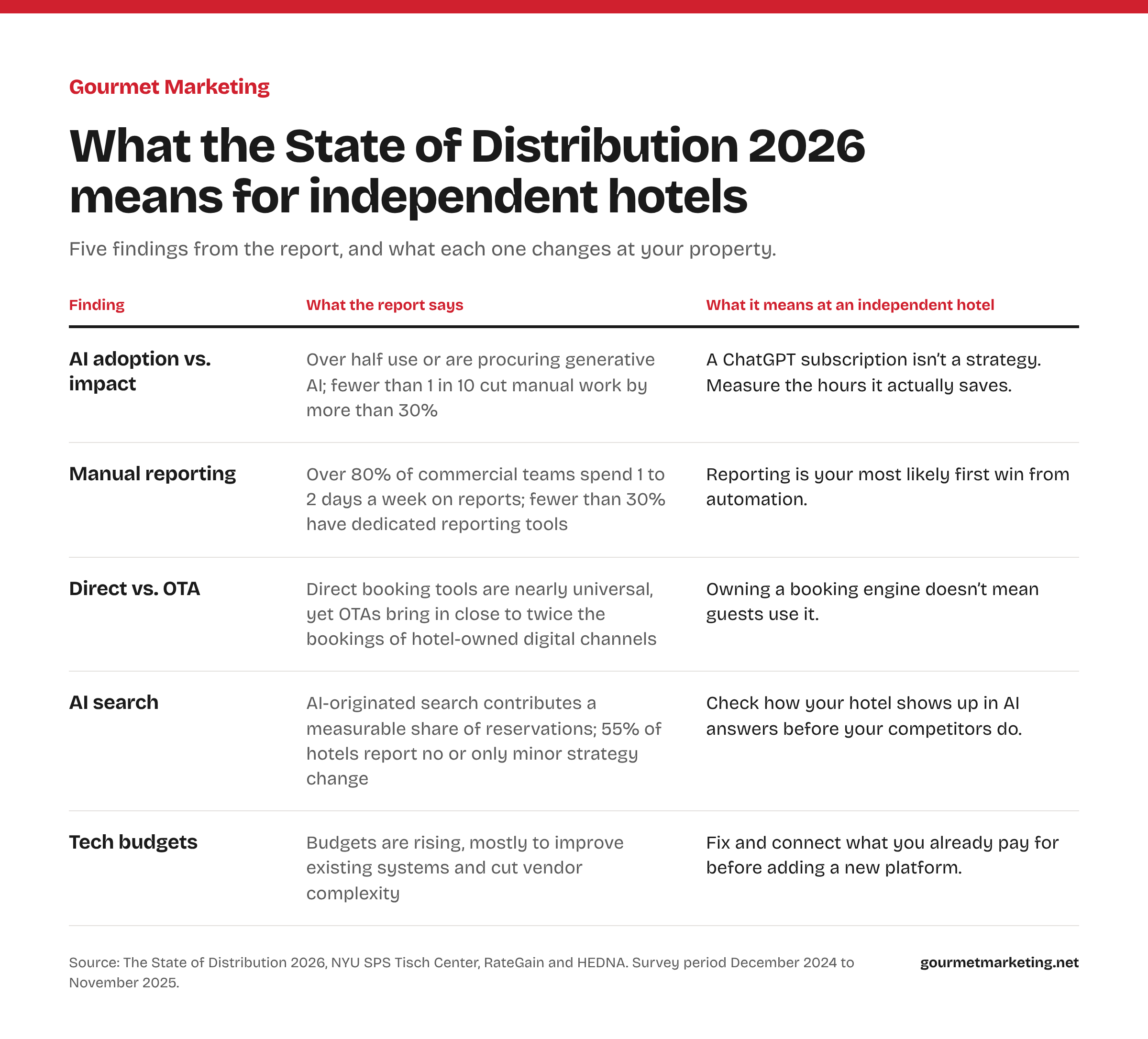
That gap sits at the center of the State of Distribution 2026 report. More than half of hotels now use or are buying generative AI, yet fewer than one in ten say it has cut their manual work by more than 30 percent. So is the average hotel distribution strategy keeping up with AI? Mostly, no. Hotels have bought tools faster than they've fixed what those tools depend on: clean data, connected systems, and a clear owner for each decision.
This post breaks down what the report found, the Google change this fall that matters more to independent hotels than any AI purchase, and a simple way to decide where your next technology dollar should go.
What did the State of Distribution 2026 report find?
The State of Distribution 2026, released September 15, 2026 by NYU SPS's Tisch Center, RateGain and HEDNA, found that AI adoption is common but real impact is rare. OTAs still outsell hotel-owned channels, commercial teams still build reports by hand, and 55 percent of hotels haven't meaningfully changed their distribution strategy despite AI search already producing bookings.
It's a big sample. According to the report announcement, the research draws on more than 270 hotel brands and 58,000+ properties across 141 cities and 53 countries. Respondents work in revenue management, marketing, distribution and sales, and the analysis compares independent hotels with mid-sized and large chains.
How should you read these numbers?
Carefully. The survey covers December 1, 2024 through November 30, 2025, so it's a recent benchmark, not a live snapshot of this month. "Use or are procuring" blends hotels already running AI with hotels still shopping. And 58,000 represented properties is not 58,000 people answering a survey; a single brand respondent can speak for hundreds of hotels.
One finding deserves more attention than it got. The report names mid-sized chains as a commercial "sweet spot," with stronger alignment across teams, more reporting automation and the most meaningful AI-led reductions in manual work. They're big enough to invest and small enough to avoid silos. A 40-room independent can copy the habits even without the budget: one weekly meeting where sales, revenue and marketing look at the same numbers, and one person who owns each system.
For the wider demand picture behind these numbers, see our breakdown of travel industry trends for 2027.
What is a hotel distribution strategy?
A hotel distribution strategy is your plan for which channels sell your rooms, at what rates and at what cost, and how you steer demand toward the most profitable ones. It covers your website and booking engine, OTAs, metasearch, the GDS, wholesalers and group sales, plus the data that tells you which is working.
A few terms come up constantly. An OTA (online travel agency) is a site like Booking.com or Expedia that sells your rooms for a commission. Metasearch is a price comparison layer, such as Google Hotel Ads, that shows rates from several sellers and sends the click to whoever the guest picks. Rate parity means offering the same room rate on every channel where your hotel is sold.
Here's the opinion part. A good distribution strategy doesn't try to kill the OTAs. They fill midweek gaps and reach travelers you'd never find on your own. The strategy decides which demand you're willing to pay 15 to 25 percent commission for and which you should be winning directly.
Why hasn't AI cut hotels' manual work yet?
Because most hotels pointed AI at the easy tasks, like drafting emails and summarizing reviews, while the real time sink is reporting built on disconnected systems. The State of Distribution 2026 found over 80 percent of commercial teams spend one to two days a week producing reports by hand, and fewer than 30 percent have invested in dedicated reporting tools.
AI sitting on top of messy data just produces confident, wrong summaries faster. If the PMS counts an Expedia Collect booking one way and your booking engine counts a cancellation another, the AI won't notice. It'll average them.
The report also found hotels trust AI for assistance, not autonomy. Teams are happy to let it draft and summarize but cautious about letting it make decisions or act on its own. We think that's the right instinct. A wrong draft costs you a rewrite. A wrong rate pushed to every channel at 2 a.m. costs you a weekend of underpriced rooms.
That's also why the report says tech budgets are going toward improving existing systems rather than buying new ones. For most independent hotels, the highest-return project this winter is getting the PMS, booking engine and channel manager to agree on what a booking is.
Why do OTAs still outsell hotels' own websites?
OTAs still bring in close to twice the bookings of hotel-owned digital channels, the report found, even though nearly every hotel now has direct booking tools. A booking engine accepts reservations. It doesn't tell you which ad, search or email created the demand, why a guest left, or why she booked the same room on Booking.com an hour later.
Here's a common scene. A couple finds your inn on Instagram, checks Google, sees your room at $219 on the hotel card next to $209 on an OTA, and books the OTA. Your booking engine never knew they existed. Your social report shows engagement. Nobody connects the two.
Speed loses bookings too. If a guest emails a question about the pet policy and hears back the next morning, the OTA has already answered with an instant confirmation. We wrote about that gap in Your Front Desk Answers Inquiries in 4 Hours. Booking.com Answers in 4 Seconds.
How to audit one booking from search to reservation
Pick a real direct reservation from last week and trace it backward. It takes an afternoon and usually shows more than a dashboard does.
- Find the reservation in your PMS and note the source code it was given.
- Look up the same booking in your booking engine and check whether the original traffic source (Google, email, social, metasearch) was captured.
- Check Google Analytics for that session and confirm the source matches. If the booking engine sits on a separate domain, this is where tracking often breaks.
- Open your Google hotel card on your phone, logged out, for the same dates and note whose price appears first.
- List every place someone had to export or retype data to get this booking into your monthly report.
- Fix the first broken link in that chain before buying anything new.
What changed on Google in 2026 that affects independent hotels?
Two things. On September 30, 2026, Google ended its third-party rates option, so Hotel Ads campaigns without a direct price feed stopped serving, including in the booking module on your hotel card. And Google's AI Mode now lets U.S. travelers book through a short list of OTAs and big chains, with no independent hotels included yet.
The price feed change is the urgent one. Until this fall, a hotel could run Google Hotel Ads without sending Google its own rates, because Google pulled prices from other sites on its behalf. Google's help page says affected campaigns now stop serving across all Hotel Ads inventory. To come back, you need a direct price feed through a Hotel Center account or an integration partner (most booking engines can be one), and you have to rebuild the campaigns.
What does that look like for a guest? Your Google hotel card can show Booking.com, Expedia and smaller resellers in the booking module, while your own website appears as a plain link with no price. In an October spot check reported by Hospitality Net, six of 17 independent hotels in five European cities had lost their own price on their Google Maps cards.
The same piece reports that since August 27, AI Mode has let U.S. travelers book hotels through ten companies: Booking.com, Expedia, Hotels.com, Priceline, Trip.com, Choice, Hilton, IHG, Marriott and Wyndham. Google hasn't said how or when an independent hotel could join. For now, the AI answer for your property still ends on your hotel card. That makes the card the most important piece of digital real estate you own.
This is the insight we'd put above every AI conversation this quarter: the cheapest distribution fix of the year has nothing to do with AI. It's a price feed. If you're not sure how your metasearch is set up, start with our explainer on what hotel metasearch advertising is and what it costs, or ask whoever manages your hotel advertising one direct question: "Where do the rates in our Google Hotel Ads come from?"
A five-minute check you can do today
- Search your hotel's name on your phone in a private browser window and open the hotel card.
- Pick dates two weeks out and note every price in the booking module, and whether yours is there.
- Repeat for a Saturday in your busy season.
- Screenshot both and send them to whoever runs your booking engine or ads.
How should a hotel choose its first AI project?
Pick one recurring task that has a clear owner, eats measurable time and produces something a person can check. For most hotels that's weekly channel reporting: standardizing the exports, flagging missing data and drafting the summary. Set the baseline first, then judge the tool by hours saved and whether decisions got faster.
"Use more AI" isn't a goal. "Cut Monday's channel report from five hours to one" is. That framing also tells you where to stop. A drafted summary that a person reviews is low risk. A tool that changes live rates or availability on its own is high risk and needs tighter controls, sign-off rules and a way to roll back.
We go deeper on budgeting for this in Your Hotel's 2027 AI Strategy: Four Questions to Answer Before Budget Season.
Copy this: the one-page AI workflow brief
Fill this in before you sign a contract or start a free trial. If you can't complete a line, the project isn't ready.
- Workflow: [the task, e.g. weekly channel performance report]
- Owner: [one name, not a department]
- Source data: [PMS, booking engine, channel manager, Google Analytics, OTA extranets]
- How the data gets checked: [who confirms the numbers match, and how often]
- Today's baseline: [hours per week, error rate or delay]
- What needs human review: [e.g. anything sent to owners, anything that changes a rate]
- What the AI may never do alone: [e.g. change rates, availability or ad budgets]
- Success after 30 days looks like: [e.g. report ready by 10 a.m. Monday in under 1 hour]
- Decision date: [when you'll expand, change or cancel]
How can a hotel measure bookings from AI search?
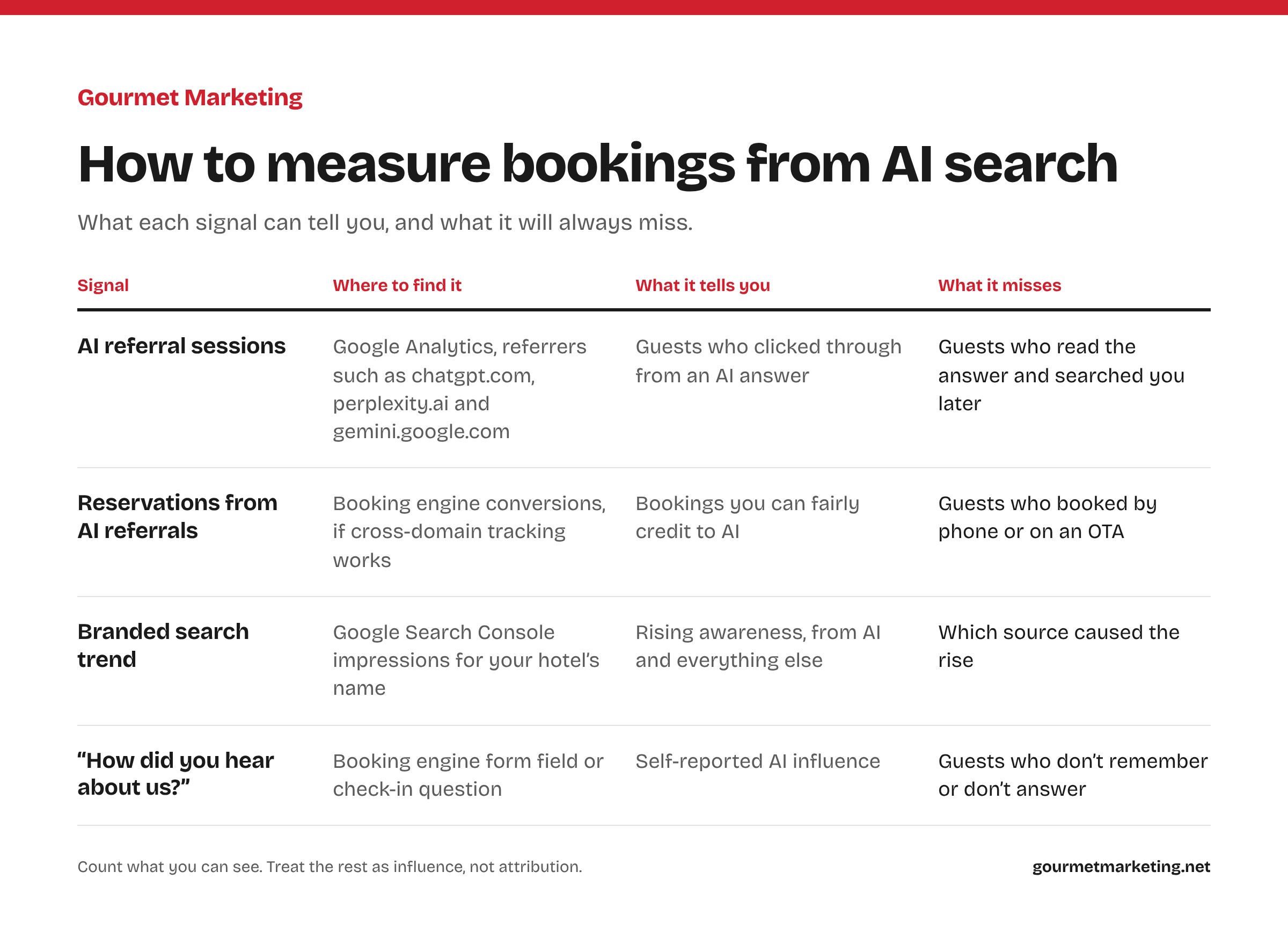
Separate three things: visits referred by AI tools, reservations from those visits, and wider influence, like guests who hear about you in an AI answer and later search your name. Only the first two can be counted reliably. Don't use one industry figure to predict what a new AI visibility campaign will return.
The headline numbers point in different directions, which is why you need your own. The State of Distribution 2026 says AI-originated search already contributes a measurable share of reservations. Booking Holdings, as reported by Hospitality Net, told investors in August that AI assistants such as ChatGPT bring in well under 1 percent of its room nights. Both can be true. Direct clicks from AI are small. Influence is bigger and harder to see.
To show up in those answers in the first place, read what AI search means for hotel discovery, then work through the five things on your hotel website that decide whether AI recommends you.
Where should a hotel put its next technology dollar?
Start with your biggest commercial bottleneck, not the newest tool. A purchase earns its place only if it helps you win, convert or keep valuable bookings, or saves time you can measure. If you can't name the problem it solves and the number that will prove it, keep the money in the budget for now.
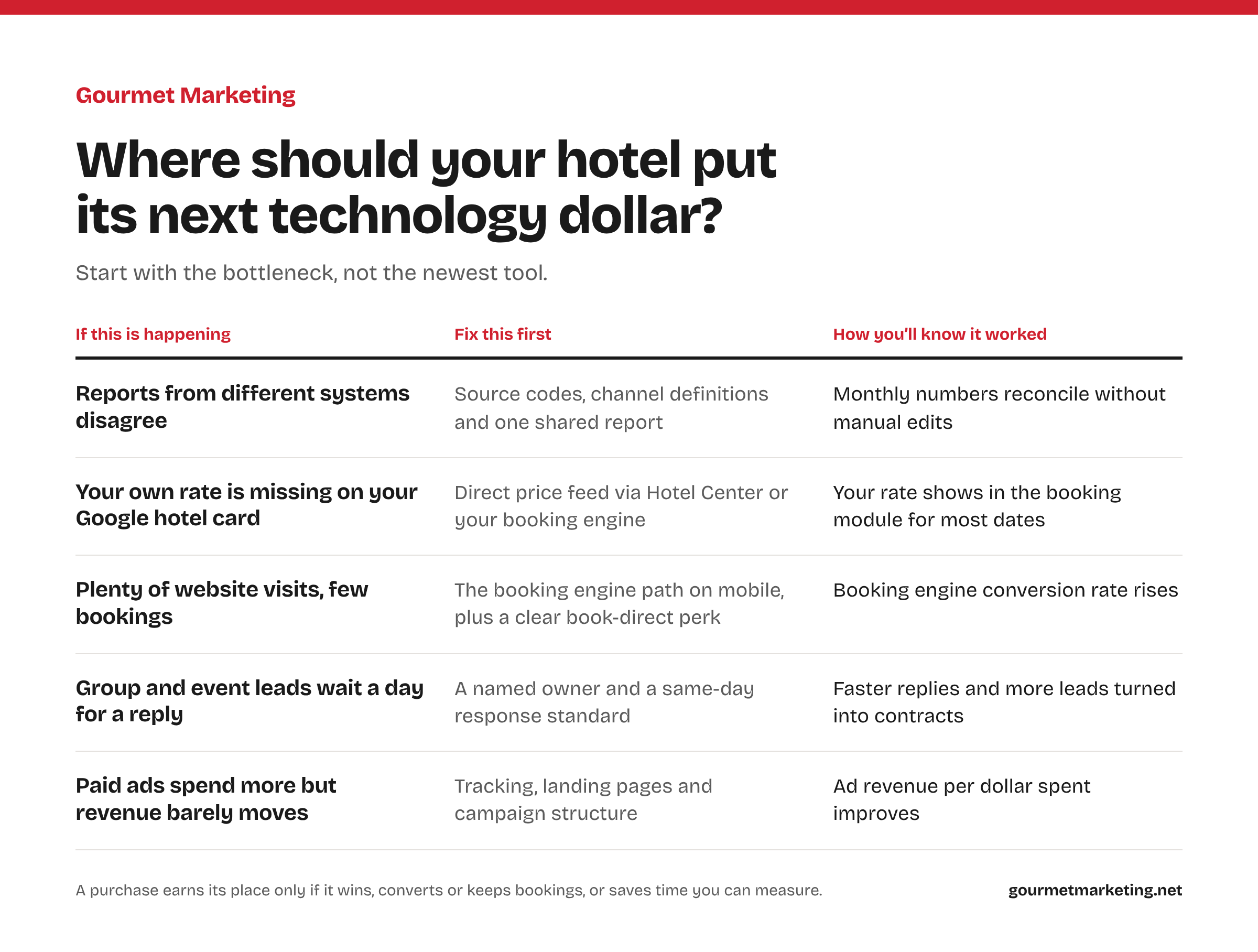
That last row is common enough that we wrote a whole post on it: why hotel ads underperform and what to fix.
Hotel Distribution and AI FAQs
What is a hotel distribution strategy?
A hotel distribution strategy is the plan for which channels sell your rooms, at what rates and at what cost. It covers your website and booking engine, OTAs like Booking.com and Expedia, metasearch such as Google Hotel Ads, the GDS and group sales. A good one doesn't try to cut OTAs out. It decides which demand you'll pay commission for and which you'll win directly.
How many hotel bookings come from AI search right now?
Very few, if you count only bookings that click straight through. Booking Holdings told investors in August 2026 that AI assistants such as ChatGPT bring in well under 1 percent of its room nights. The State of Distribution 2026 says AI search already drives a measurable share of reservations. The bigger effect is influence: guests who hear about you in an AI answer, then search your name.
Do independent hotels need their own price feed for Google Hotel Ads?
Yes, if you want to keep appearing in Google Hotel Ads. Google ended its third-party rates option on September 30, 2026, and campaigns that relied on it stopped serving across Hotel Ads placements, including the booking module on your hotel card. You now need a direct price feed through a Hotel Center account or an integration partner, which many booking engines provide.
Is it worth buying an AI tool for a small hotel?
It's worth it when the tool fixes a named problem you can measure. A small hotel that loses six hours a week building channel reports, or answers website inquiries the next morning, can test a tool against a clear before-and-after number within a month. If you can't say which task gets faster and how you'll check it, fix your data first.
What's the easiest way for a small hotel to get more direct bookings without relying on Expedia?
Start where guests already look for you. Make sure your own rate shows on your Google hotel card through a direct price feed, offer a small book-direct perk like free parking or a late checkout, and answer website inquiries within minutes instead of hours. Those three fixes catch guests who already want your hotel and are only deciding where to book it.
What should your hotel do next?
Don't start with a new tool. This week, open your Google hotel card on your phone and see whose price is there, then trace one direct booking from search to reservation. Those two checks will tell you more about your hotel distribution strategy than any vendor demo, and they'll show you exactly where your next dollar should go.
If you'd like a second set of eyes on what you find, Gourmet Marketing works with independent and boutique hotels on metasearch, hotel SEO, websites and direct booking strategy. See how we help hotels grow direct revenue.