


Open a new tab. Type your property's domain, add /robots.txt on the end, and hit enter.
Read what comes back. If you see Disallow: / sitting under a line that says User-agent: PerplexityBot or OAI-SearchBot or GPTBot, stop reading this and forward it to whoever manages your site. Your property is not underperforming in AI search. It has been switched off, possibly for years, probably by a security plugin default that nobody approved.
We run this check at the start of every audit. It takes ninety seconds. It fails more often than any hotelier expects.
That is the shape of this whole problem. Hoteliers keep being sold AI search as a strategy question, something that needs a workshop and a new budget line. It is not. It is five specific, checkable, mostly unglamorous things on your website, and most independent properties are failing at least two of them right now without knowing it.
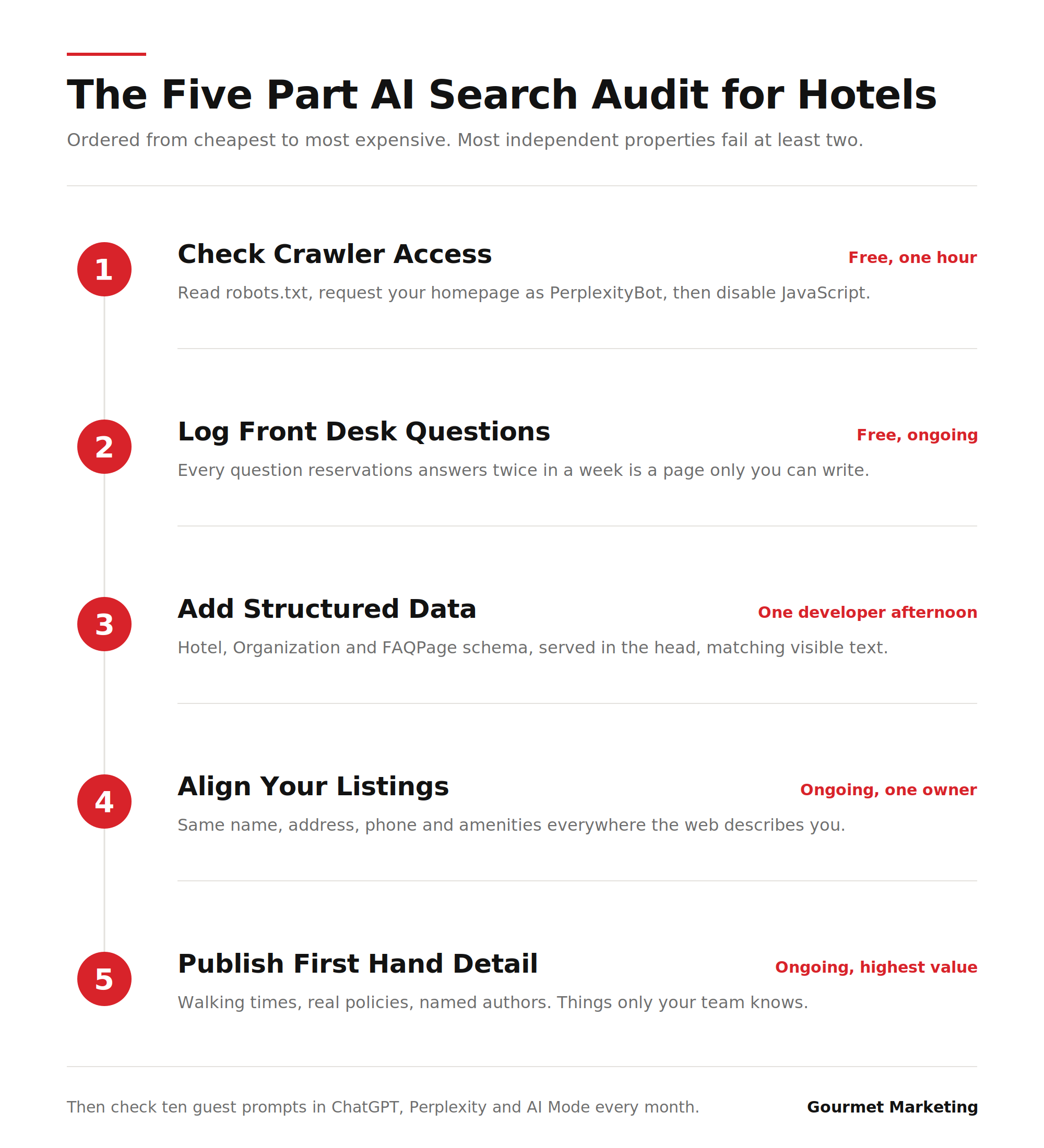
Here is the audit, ordered from cheapest to most expensive, so you can stop wherever your patience runs out.
What You Are Actually Competing For
Quick framing, because the size of this gets exaggerated in both directions.
Skift and McKinsey found 30 percent of US travelers used ChatGPT or similar tools extensively for trip planning in 2025, up from 13 percent the year before. But Expedia Group's 2026 research found only 8 percent treat an AI assistant as their primary planning tool, and roughly two thirds still would not trust one to complete a booking.
Put those together and the takeaway for a GM is simple. AI is not taking your bookings. It is deciding your shortlist. Guests ask an assistant for three properties, then go and search those three by name and book direct. That is commission free revenue, arriving through your brand traffic, generated by a channel you cannot see in your attribution reports.
Which means every one of these fixes pays out as direct bookings, not just visibility. We unpacked the wider commercial shift in what AI search means for hotel discovery. This piece is the workbench version.
One: Confirm the Crawlers Can Physically Reach You
Free. One hour. Fixes the most catastrophic failure mode.
There are two families of AI crawler and they do different jobs. Training crawlers such as GPTBot, ClaudeBot and CCBot shape what future models know about you. Retrieval crawlers such as OAI-SearchBot, PerplexityBot, ChatGPT-User and Bingbot fetch pages to answer a question a guest is asking this minute. Blocking the second group means you cannot be cited in live answers at all.
Three checks, in this order.
Read robots.txt Properly
Not just for an outright block. Look for inherited rules from a plugin, a staging environment config that got pushed live, or a blanket disallow somebody added in 2023 when scraping was a hot topic.
Test Real HTTP Access, Not the File
This is the one that catches people. Cloudflare, WAF rules, bot mitigation and rate limiting routinely return 403s to AI crawlers even when robots.txt is wide open. OpenAI's own guidance names CDN bot protection as a common cause. Ask your developer for one thing: make a request to your homepage with the PerplexityBot user agent and tell me the status code. If it is not 200, you have found your problem.
Turn JavaScript Off and Reload Your Site
Whatever disappears does not exist to these crawlers, because they do not execute JavaScript at fetch time. For hotels this is usually devastating, because rates, room descriptions, availability and policies all live inside a booking engine iframe. If a model cannot see your room types, it cannot recommend your room types.
We have audited properties spending real money on monthly content that no retrieval crawler had successfully fetched in nearly a year. The content was fine. The door was locked.
Two: Mine Your Front Desk for the Content You Already Own
Free. Ongoing. Produces better material than any agency retainer.
Guests do not type "boutique hotel Charleston" into an assistant. They type full sentences with three constraints attached, and then they ask follow ups. Can we check in early on a Friday in August. Is your restaurant open to non guests. Is there a lift to the third floor. How much is a taxi from the airport, roughly. Is the pool heated in March.
You are the only authoritative source on earth for every one of those answers. And your reservations team already answers them forty times a week.
So log them. Ask the front desk and reservations to write down every question they field twice in a single week. You will have fifty by Friday. That is your content calendar for a year, and it maps exactly onto how people phrase things to an assistant.
Then format the answers so a machine can lift them whole.
Is Parking Available at the Hotel?
Yes. We have 14 on site covered spaces at 25 dollars per night on a first come basis. Valet runs Thursday to Sunday from 4pm, and there is a public garage two blocks away on Drayton Street.
That is the shape. Question as the header. Direct answer in the first two or three sentences. Detail afterwards if you need it. No scene setting, no brand voice warm up. Compare it to where your parking rate currently lives, which on most hotel sites is bullet point nine on a page called Guest Information.
Three: Give Machines Facts Instead of Adjectives
One developer afternoon. Do it once, maintain it quarterly.
Your homepage says something like "a sanctuary of understated elegance in the historic district." A model cannot do anything with that sentence. What it can use is structured data: a JSON-LD block stating that you are a Hotel, at this address, at these coordinates, with this many rooms, this price range, these amenities, these check in times.
The types that matter for a property:
- Hotel or LodgingBusiness with
address,geo,telephone,priceRange,checkinTime,amenityFeature - Organization with a full
sameAsarray pointing at your Google Business Profile, Instagram, TripAdvisor listing and any Wikidata entry. This is how you tell a model that all those scattered profiles are one hotel. - FAQPage on pages with real, visible questions and answers
- Article on editorial content, attributed to a named person with a title
- Event for weddings, tasting dinners, anything with a date
Three things people get wrong. Deliver it server side in the document head, because schema injected through a tag manager is invisible to crawlers that do not run JavaScript. Every claim in the markup must match something a human can see on the page. Use full ISO 8601 dates.
Now the honest part, because the schema conversation has gone slightly mad and you are probably being quoted four figures a month for it. Ahrefs analyzed 6 million URLs and found pages cited by AI were around three times more likely to carry JSON-LD. Then they tested whether adding it actually caused anything, tracking 1,885 pages against 4,000 controls, and found no statistically significant citation lift on ChatGPT, AI Mode or AI Overviews. Google has said outright there is no special markup required for generative results.
So treat schema as labeling the boxes in a warehouse. It does not create demand for what is inside. It does stop the wrong thing being shipped. For a hotel, where amenity and rate facts get garbled constantly and an assistant will happily tell a guest about a spa you closed in 2019, that is worth an afternoon. It is not worth a retainer on its own. And it is not a substitute for putting those same facts in visible text on the page, which is what these systems actually read.
Four: Make the Rest of the Internet Agree With You
Ongoing. Cheap to fix, expensive to ignore.
Models cross reference your site against everything else the web says about you, and disagreement reads as unreliability. If your own site lists eleven amenities and TripAdvisor lists fourteen and your tourism board page has your old phone number, the model has to choose, and it will not always choose you.
Two jobs here.
Consistency
Property name, address, phone number and core description identical across your website, Google Business Profile, TripAdvisor, OTA listings, tourism board pages and every directory you have ever been added to. Boring. Unavoidable. Assign it to one person with a spreadsheet.
Presence in High Trust Places
Regional press, travel publications, curated destination guides, genuine review platforms, Reddit threads about your city. Earned media has quietly become a technical asset. The writer who mentions your rooftop bar in a regional round up is now feeding both a training corpus and a live retrieval index. Hotel PR just started paying twice.
Five: Publish Things Only You Could Publish
The hardest to fake, and increasingly the whole ballgame.
These systems are being tuned to discount generic filler, and the web is saturated with hotel content that reads like it was produced in bulk, because it was. What survives is density and first hand knowledge.
Your neighborhood guide should include the walking time, the fact that the restaurant does not take Sunday reservations, and which of the three entrances has the good bar. Your seasonal content should say when the crowds actually thin and what the light does in October. Attribute it to your GM or head concierge by name, with a bio that explains why they know.
Your own numbers help too. Booking windows, guest mix by season, occupancy patterns. Nobody else on the internet has them.
How to Know Whether It Worked
First Monday of every month. Twenty minutes. No software required.
Write eight to ten prompts a real guest would type. Run them through ChatGPT, Perplexity and Google's AI Mode. Log three columns: did we appear, how were we described, who appeared instead.
Three months gives you a trend. Six gives you the name of the competitor eating your shortlist and usually the reason why. Pair it with a GA4 view filtered to referrals from assistant domains and you have enough to defend the spend at budget time. That measurement habit is the actual difference between properties making progress and properties buying tools, which we broke down in what is working and what is stalling with AI in hotels.
Start With the Ninety Second Check
None of this is a rebuild. It is plumbing. Crawler access this week, front desk question log by Friday, schema next month, listings cleanup whenever someone has a quiet afternoon.
The properties winning shortlists in 2027 will not be the ones with the most poetic homepage. They will be the ones a machine could read correctly at 3am while a guest six time zones away asked a question about a city you have never run a campaign in.
If you want an outside read on where your property stands, we run AI visibility and local SEO audits for independent hotels covering all five areas above, crawler access test included. Most turn up at least one fix that takes a day and should have been done two years ago.
Frequently Asked Questions
Why Is My Hotel Not Showing Up in ChatGPT or Perplexity?
The most common cause is access, not content. Either a robots.txt rule or a bot protection layer is blocking the retrieval crawlers, or your rates and room information only render through JavaScript, which those crawlers do not run. Check both before assuming you have a content problem.
Does My Hotel Need Schema Markup to Appear in AI Search Results?
No, schema is not required, and Ahrefs found no proven citation lift from adding it. What it does reliably is remove ambiguity about your address, amenities, rates and identity, which is worth doing because hotels get those facts misrepresented more than most businesses. Treat it as accuracy insurance rather than a visibility lever.
Should I Block GPTBot and Other AI Crawlers From My Hotel Website?
Not if you want to be recommended. Blocking training crawlers such as GPTBot is a defensible position if you object to model training, but blocking retrieval crawlers such as OAI-SearchBot and PerplexityBot removes your property from live answers guests are getting right now.
What Is the Difference Between SEO and AEO for Hotels?
SEO works to earn a position on a results page. AEO, or answer engine optimization, works to be named inside an answer where there is no results page at all. They share most of the same foundations, which is why properties with strong existing SEO tend to appear in AI answers more often.
How Long Does AI Search Optimization Take to Show Results?
Crawler access fixes can change things within days once the pages are refetched. Content and entity work usually takes two to three months to show up consistently in AI answers, and earned media effects take longer than that. Run a monthly prompt check so you can see movement rather than guess at it.
How Do I Track Bookings That Came From an AI Assistant?
Most of them will not appear as AI traffic at all. The guest gets a shortlist from an assistant, then searches your brand name and books direct, so the revenue lands in branded organic. Watch branded search volume and direct booking share alongside a GA4 filter for referrals from assistant domains, and read them together rather than separately.
Can I Do This Myself or Do I Need an Agency?
Most of the five fixes are in reach of an in house team with developer access. The robots.txt check, the front desk question log and the listings cleanup need time rather than expertise. Schema implementation and ongoing entity work are where properties usually bring in help.
Do I Need a New Website for Any of This?
Almost never. These are configuration and content changes on the site you already have. A rebuild only becomes the answer if your content is locked inside a platform that cannot render server side HTML.
Prepared by Gourmet Marketing, a hotel digital marketing agency specializing in SEO, content, and direct booking growth for boutique and luxury properties.