


This article was prepared by Gourmet Marketing, a hotel marketing agency specializing in strategy, branding, and digital growth for hotels.
It's one of the most common questions we hear from hotel marketing and revenue teams: how much of the Google Ads budget should go to Brand campaigns, and how much to Non-Brand? The answer depends on where the property is, where it's going, and what the data is showing. But there is a clear framework for thinking it through.
This guide covers both campaign types, why the split matters for hotel paid search, and four practical scenarios to help find the right balance for a given property.
Two campaign types, two different jobs
For hotels, Brand and Non-Brand campaigns in Google Ads serve fundamentally different purposes.
Brand campaigns target people already searching for a hotel by name. They have discovered the property somewhere, maybe through a listing, a recommendation, or a review, and they are searching to come back and book. The campaign's job is to make sure the first result they see leads to the direct booking engine.
Non-Brand campaigns work earlier in the journey, reaching people searching for a hotel type or destination rather than a specific property. They are a discovery channel, and the way hotel paid search introduces a property to guests who do not know it yet.
Both have a role in a well-rounded hotel marketing strategy. The question is always one of sequencing and proportion.
What happens when Brand goes unprotected
When Brand campaigns are paused or underfunded, demand does not disappear. Instead, it gets redirected. OTAs and third-party platforms regularly bid on hotel brand terms, which means their listings can appear prominently when someone searches for a hotel's name. A guest who clicks through to a third-party platform may still book the property, but via a channel that carries a commission cost. In some cases, they encounter competing properties on that platform and do not return at all.
This is what is referred to as brand leakage, and it tends to be underestimated, partly because it does not show up in the hotel's own analytics.
Across the Gourmet Marketing hotel portfolio, Google Search Console data consistently shows that only 10 to 25% of Brand keyword impressions result in a click to the hotel's own organic listing (even for properties that hold the top organic position). The remaining impressions go to paid listings, Google Hotel Finder modules, aggregators, or produce no clicks at all. That is a significant share of high-intent demand that never reaches the direct channel without paid support.
When we have analyzed what happens to Brand traffic after campaign pauses, we find that only around 11% of that paid volume is recovered organically. For most hotels, a well-funded Brand campaign is the most reliable way to ensure those guests land where they need to.
A useful starting check: The Auction Insights report in Google Ads shows which platforms are appearing alongside Brand ads, and how often. The Position Above Rate column is worth paying close attention to because it shows how frequently a competitor's ad appears above the hotel's own. If that figure is significant for major platforms, it is a useful signal for how well Brand coverage is holding up.
The four budget scenarios
Rather than a single recommended split, it helps to think in terms of four scenarios. Each reflects a different balance between Brand protection and audience acquisition, and each suits a different type of hotel or stage of account maturity. These are sometimes referred to as the 0/20/50/80 scenarios, based on the Non-Brand share of budget in each case.
Scenario 1 - 100% Brand / 0% Non-Brand
All budgets support Brand coverage. Strong protection of hotel direct booking traffic with no paid investment in reaching new audiences. A good fit when the budget is limited, Brand coverage is the priority, or the Non-Brand has not been tested yet, and a baseline needs to be established first.
Scenario 2 - 80% Brand / 20% Non-Brand
Strong Brand defence with a modest Non-Brand allocation. A low-risk way to start building Non-Brand performance data without meaningfully reducing Brand coverage. Our recommended starting point for most hotel properties.
Scenario 3 - 50% Brand / 50% Non-Brand
A balanced approach. Non-Brand now has enough budget to generate meaningful data and reach new audiences, while Brand coverage stays reasonably healthy. Works well once Non-Brand is converting at or above benchmark and hotel direct bookings are stable.
Scenario 4 - 20% Brand / 80% Non-Brand
Growth-oriented. Heavy investment in new audience acquisition, with Brand coverage at a minimum. Requires a strong organic presence to offset reduced paid Brand support. Best suited to a hotel in a launch or rebrand phase, or properties with robust organic visibility.
How the scenarios compare
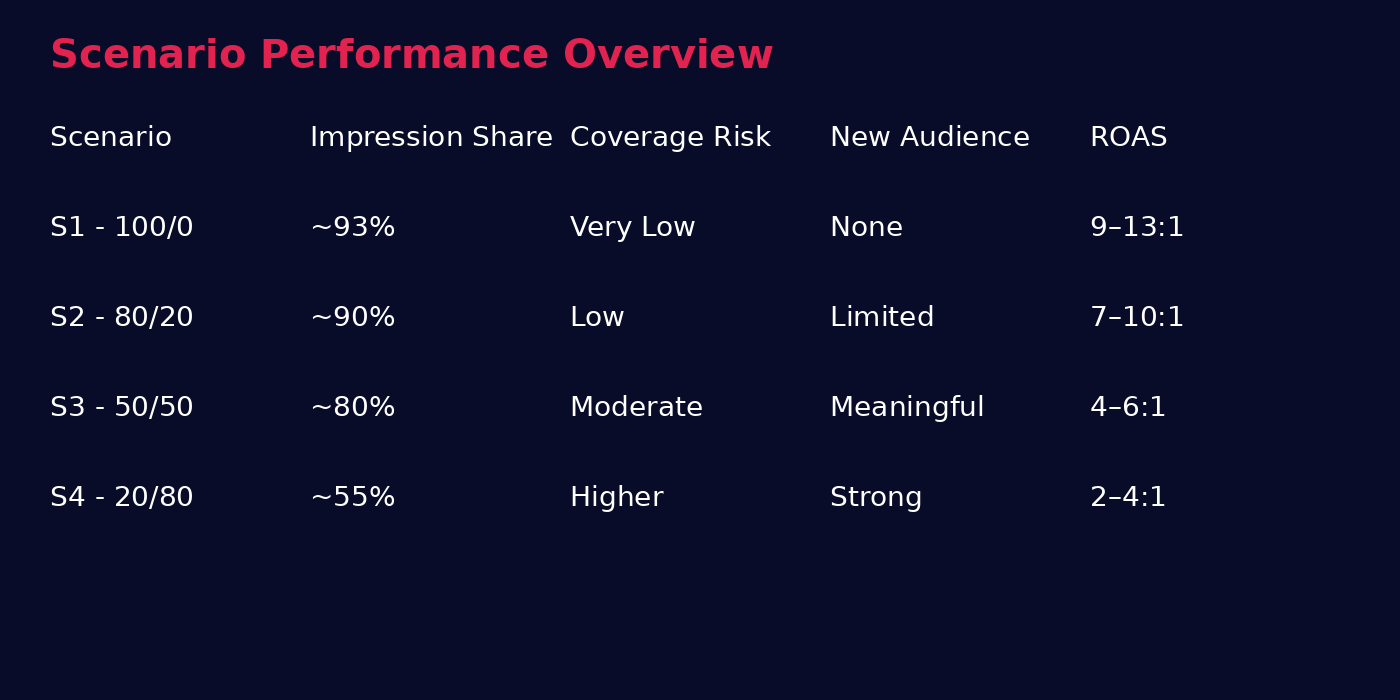
Brand Impression Share estimates are directional, scaling from a benchmark of around 88% at a 50/50 split. Blended ROAS uses typical Gourmet Marketing hotel metrics portfolio ranges: Brand 8 to 13:1, Non-Brand 2 to 5:1 when properly optimised.
To put the coverage risk in practical terms, here is how the scenarios model out at a total monthly Google Ads budget of $8,000, with a $~$800 average booking value:
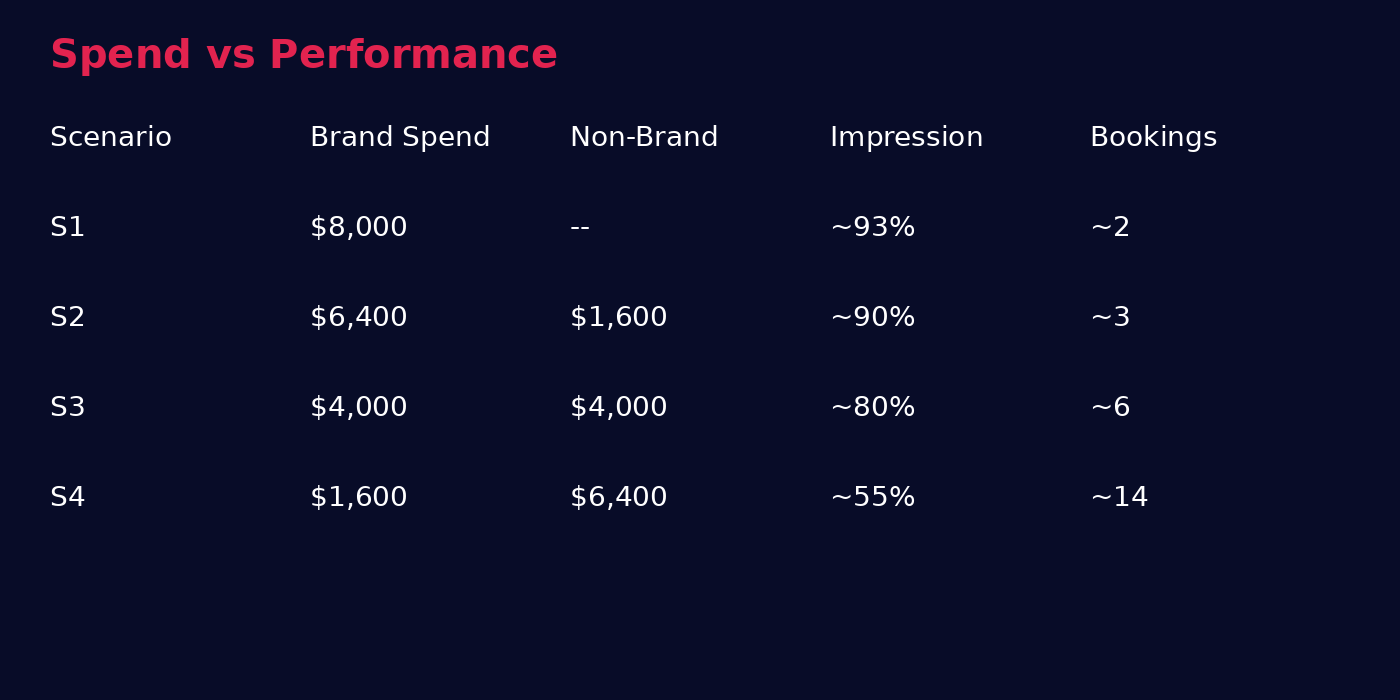
Illustrative model based on $8,000/month total budget. Bookings at coverage risk are directional estimates based on typical third-party capture rates on unprotected Brand impressions.
A note on Non-Brand performance
The hospitality benchmark for Non-Brand conversion rate is 0.8 to 2.5%. In practice, hotel accounts often run well below this, not because Non-Brand hotel advertising does not work, but because of keyword structure issues. Broad match terms attracting informational queries, or geographic targeting that is too wide, can generate high click volumes at low cost while delivering few bookings. Before allocating more budget to Non-Brand, it is worth reviewing the Search Terms report to confirm the campaign is reaching people with genuine booking intent.
Is Brand revenue truly incremental?
It is a fair question and worth addressing honestly. Brand campaigns are partially incremental, so some guests clicking on a Brand ad would have found the hotel website organically anyway. The question is how many, and without a controlled test, it is difficult to know for any individual property.
The case for caution on Brand spend usually rests on a few reasonable points: last-click attribution may inflate Brand return on ad spend by crediting the ad for bookings that were already decided; hotels with distinctive names and loyal guests may recover more traffic organically than average; and the opportunity cost of Brand spend (budget that could instead reach new guests via Non-Brand hotel marketing) is real.
On the other side, hotel metrics reporting from Gourmet Marketing offers some consistent signals. Google Search Console shows that organic listings capture only 10 to 25% of Brand impressions even at the top organic position. Search results pages today include Hotel Finder panels, paid listings, and aggregator results that can divert high-intent guests before they reach an organic link.
Case study: Hotel Lucerne and Hotel Wallace, New York City
Both the Lucerne and Wallace properties ran Brand-only Google Ads campaigns for three years, supported by SEO, Google Hotel Finder, email marketing, and blog content by Gourmet Marketing, with zero Non-Brand spend over the entire period.
- Direct revenue doubled: from $6 million to $12 million
- Direct booking share reached 70%
- Over $1 million in additional direct revenue per property in year one
- Over $7 million in additional direct revenue across the group
Demand was being generated through OTAs, metasearch, and organic discovery. Brand campaigns converted that demand on the direct channel without any Non-Brand hotel advertising investment at all.
Case study: Empire Hotel Group, seven properties
The Empire Hotel Group's seven hotels ran Brand-only campaigns in their first year working with Gourmet Marketing’s digital marketing team, with no Non-Brand advertising across the group.
Google Search Console data confirmed that organic was capturing only 10 to 25% of Brand impressions across the portfolio. Brand campaigns captured the remainder before it reached third-party channels.
If incrementality is genuinely in question for a specific hotel, the most practical test is a short Brand pause during a lower-demand shoulder period of two to four weeks, monitored against Search Console organic click data and direct booking volume from the property management system. It carries some revenue exposure during the pause, but it is the cleanest data available.
Where to start and how to progress
For most hotel properties, Scenario 2 (80/20) is a sensible starting point for Google Ads. It maintains strong Brand coverage while opening a real test window for Non-Brand hotel paid search. The goal over time is to reach Scenario 3 (50/50) once Non-Brand is performing consistently at or above the benchmark.
Before shifting any budget, three checks are worth making:
- Review the Non-Brand Search Terms report. Is the campaign matching to booking-intent queries, or informational ones? A Non-Brand cost per click significantly below the $2.80 to $6.50 hospitality benchmark usually signals the campaign is attracting the wrong traffic.
- Verify conversion tracking. Brand conversion rates below 1.5% typically point to a tracking gap rather than a genuine performance issue. Confirming what event is being counted, and cross-referencing it against property management system records, matters before making budget decisions based on return on ad spend.
- Check Auction Insights. A high Position Above Rate from major platforms is a prompt to review whether Brand coverage is where it needs to be before any reallocation.
A three-month path
Month 1: Run at 80/20. Focus on Non-Brand keyword quality and conversion tracking accuracy before drawing conclusions from performance data.
Month 2 review: If Non-Brand conversion rate is approaching 0.8% and Brand Impression Share is holding above 80%, consider moving toward 70/30 or 50/50. If Non-Brand is still structurally underperforming, hold at 80/20 until the keyword issue is resolved.
Month 3 onwards: With a well-structured Non-Brand campaign and a meaningful data record, a confident allocation decision becomes possible. Target Scenario 3 if Non-Brand is performing; hold at Scenario 2 if Brand coverage metrics suggest otherwise.
On Performance Max: Many hotel Google Ads accounts run a Performance Max campaign alongside Brand and Non-Brand search. In practice, a significant portion of Performance Max conversions tend to be driven by Brand intent, which means underfunding Brand can weaken Performance Max results too. When evaluating Non-Brand search performance, keep Performance Max separate in reporting to get a clear picture of each campaign type.
When to revisit the balance
The 80/20 starting point suits a steady-state hotel property, but several conditions point toward a different approach:
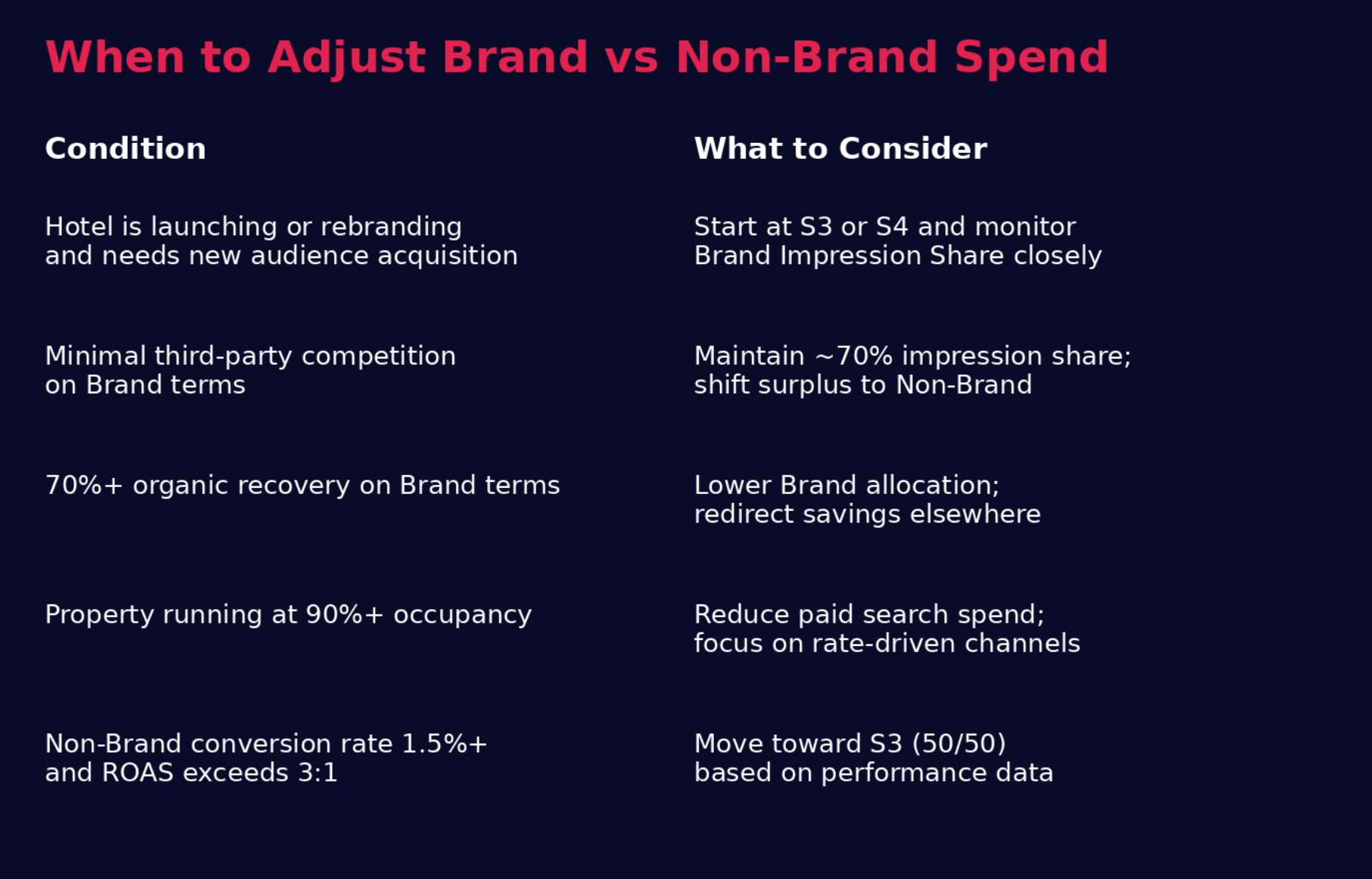
Once Brand Impression Share is consistently above 80 to 85% and Lost Impression Share from budget is low, additional Brand spend is unlikely to generate proportional gains. At that point, the focus naturally shifts: booking engine conversion, on-site personalisation, retargeting for guests who visited but did not book, and Non-Brand campaigns to grow the top of the hotel marketing funnel.
Brand campaigns capture existing demand. Everything above in the funnel creates new demand. Getting the sequence right matters as much as getting the split right.
Sources: Gourmet Marketing hotel portfolio analysis (Google Search Console, 2024 to 2026; Hotel Metrics); Google Ads benchmarks, Hospitality Vertical (2024); WordStream Google Ads Industry Benchmarks (2024); Tinuiti Hotel Digital Marketing Report (2023).