


Every F&B budget has a line for beverage, and at most properties that line is set the same way: last year's number, plus a few points. Nobody argues about it. Rooms takes the debate, the marketing budget takes the rest of it, and beverage gets indexed up in about four seconds.
Stop at that line.
It carries an assumption most properties have not tested in three years: that beverage revenue moves with food revenue. It used to. It does not now. The gap between those two lines is where a meaningful amount of departmental profit has been going, and because of how it shows up on the P&L, it produces no variance, no flag, and no conversation until somebody in the ownership meeting asks why departmental profit slipped.
This piece gives you three things: the data behind the split, the two operational causes, and the questions to answer before you write the number.
Food and Beverage Stopped Moving Together
CBRE analyzed the operating statements of 2,669 U.S. full-service, resort, and convention hotels participating in its annual Trends in the Hotel Industry survey. The split is clean and it is uncomfortable. Food revenue rose 5.2% in hotel venues and 4.0% in banquet spaces. Over the same period, beverage revenue was flat in venues and declined by 2.0% at banquets.
Context sharpens it. That happened while rooms revenue grew 0.8% in the first half of the year against a full-year RevPAR forecast of 0.1%.
Rooms growth under a percent sends everyone to the same two places: harder on direct bookings, heavier on ancillary revenue. Most properties defend the first with paid media and assume the second takes care of itself. It partly did. F&B grew 3.8% and outpaced overall hotel revenue growth.
But that growth was food. Beverage contributed nothing to it.
Beverage Is the Line You Can Least Afford to Guess On
Every F&B director already knows why this stings. Pour cost on a well-run beverage program runs in the high teens to low twenties as a share of revenue. Food sits ten to fifteen points above that. Beverage is not a large line. It is a profitable one. A dollar of lost beverage revenue costs the department roughly a dollar and a half of profit compared with a dollar of food.
The decline also hides well. CBRE noted that the rise in cost of goods sold was tempered by a reduction in the cost of beverages, commensurate with the decline in beverage revenues. Your cost percentage holds. Your variance report looks clean. The department simply earns less, and no line item announces it.
Hotels are good at interrogating money that leaves loudly. Nobody signs an OTA agreement without arguing about what the commission actually costs, and most marketing teams can name where their ad spend is being wasted. A flat beverage line gets none of that scrutiny, and it is costing more than either.
This Is a Preference Shift, Not a Soft Quarter
The easy read is that traffic dropped. It did not. Covers held. What changed is what those covers order.
CBRE attributes the shift to mindful drinking and the emergence of two new beverage categories: low-alcohol offerings and mocktail alternatives. One hotel in the sample reinvented the Shirley Temple and made it a hit at brunch, with cocktail lists that were historically adults-only now building non-alcoholic options for the whole table.
The market data agrees. IWSR projects global low and no alcohol sales growing 7% annually through 2028, driven by younger guests who drink less and treat moderation as a standing choice rather than an occasion-specific one.
Those guests research before they sit down. "Best mocktails near me" is a real query with real volume, answered increasingly by an assistant rather than a results page and won on the strength of your local search presence rather than your cocktail program.
The Mocktail Priced Like an Afterthought
Here is the scenario running in most hotel bars right now. The beverage manager, responding to guest requests, adds three non-alcoholic options to the bottom of the cocktail list. They are priced at nine dollars because they contain no alcohol, sitting under nineteen-dollar cocktails. They take the same shaker, the same garnish work, the same thirty seconds of bartender attention, and often a more expensive house-made syrup.
Run a table of four. Two guests go zero proof. That round used to be seventy-six dollars and is now fifty-six.
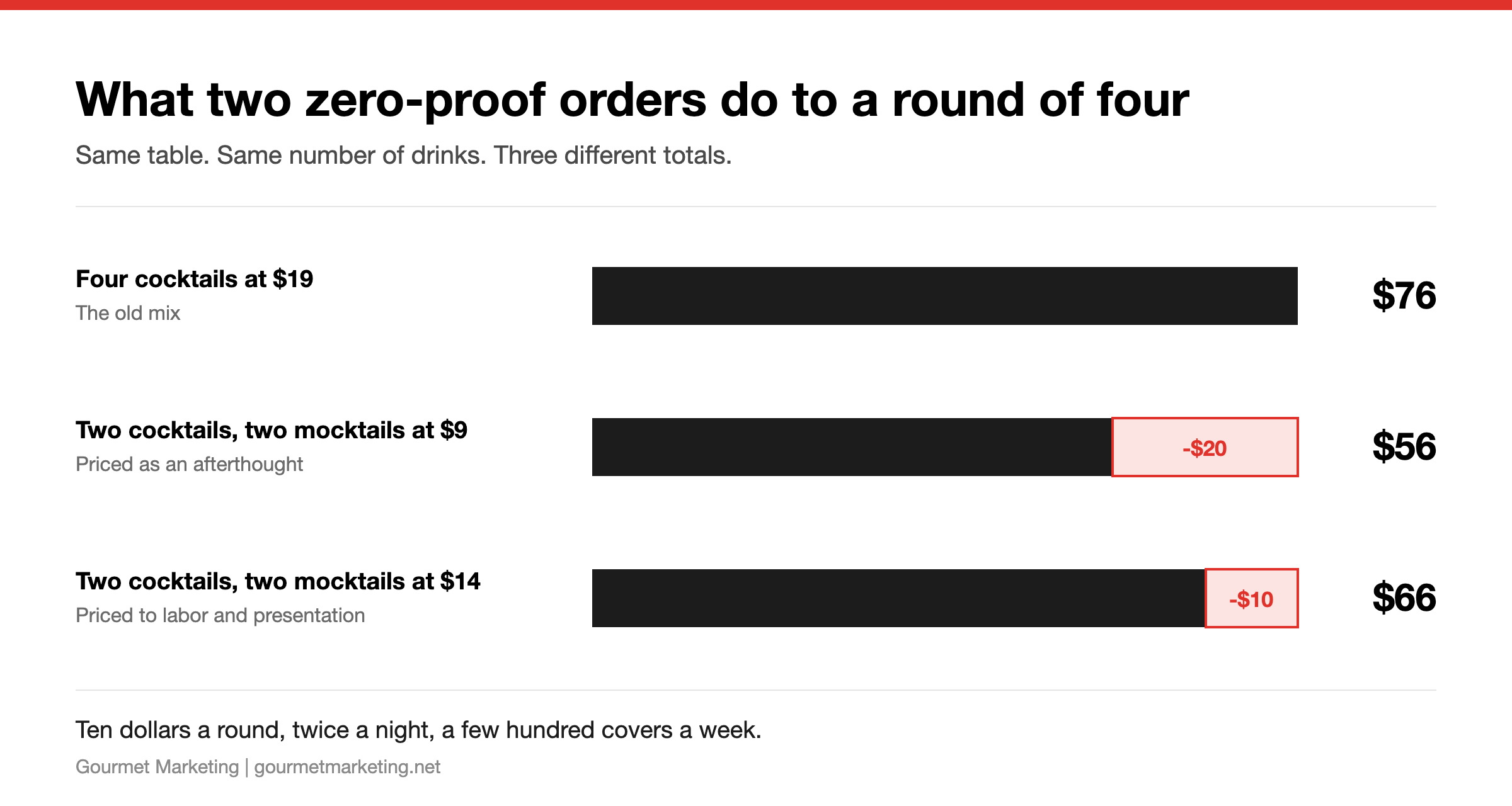
Ten dollars a round, twice a night, a few hundred covers a week. That is the flat beverage line, built one well-intentioned pricing decision at a time.
Price non-alcoholic drinks against labor, presentation, and occasion rather than against alcohol content. A well-built zero-proof cocktail at fourteen dollars is not aggressive. It is accurate. Then make the category look worth the number, because a drink that photographs well earns its own audience, and a bar with a real brand of its own can hold a price that a line on the amenities page never could.
According to Gourmet Marketing's CEO, Onur Kiyak, "Beverage is the only line in F&B where the guest is still showing up and still ordering. They are just ordering something you priced like a courtesy. That is a menu decision, not a market problem, which means it is one of the few revenue lines you can actually fix before next year starts."
Banquets Have Their Own Version of This Problem
Do not let the venue number distract from the catering number, because the banquet story splits hard by property type. Banquet revenue declined 7.3% at convention hotels while increasing 8.7% at resort hotels.
If your business is convention-driven, your banquet beverage assumptions were written for a group that drank differently. Hosted bars on consumption, priced per drink, with no non-alcoholic option inside the package, produce less revenue per attendee every year without anyone changing anything.
Move to per-person packages that include the zero-proof program instead of charging for it separately. The planner gets a cleaner number. You get per-attendee revenue back.
Most planners never see that package, because meetings and events lives behind a contact form rather than a page built to convert them, and because the follow-up after a lost RFP is usually nothing at all when a simple nurture sequence would keep you in the running for the next one.
The Demand Half of the Beverage Number
Everything above is operational. It still leaves the larger question, which is how many people walk into the outlet at all.
Most hotels treat beverage revenue as something won at the bar. It is won upstream, before a guest decides whether to leave the building, and long before a local considers you an option at all.
Treat the outlet the way an independent operator would. It needs its own pages, its own search visibility, and its own local listings rather than a mention halfway down an amenities page. Locals fill a bar on a Tuesday in February, which is also the stretch where independent hotels struggle most, and almost nobody markets to them on purpose.
Frequently Asked Questions
Why is hotel beverage revenue declining while food revenue grows? Guest preference, not guest volume. CBRE's Trends survey found food revenue up 5.2% in venues and 4.0% in banquets while beverage was flat in venues and down 2.0% at banquets. Covers held steady. The shift toward low and no alcohol drinks means the same guest spends less per visit, particularly where non-alcoholic options are priced well below cocktails.
What should I assume for beverage revenue in next year's F&B budget? Assume flat unless you can name a specific operational change that will move it. Indexing beverage up with food builds a number you cannot defend by the second quarter. If you are planning growth, tie it to repriced non-alcoholic drinks, restructured banquet packages, or new demand generation for the outlet.
How should hotels price mocktails and non-alcoholic cocktails? Price against labor, ingredients, and presentation rather than alcohol content. A zero-proof drink requiring the same build time and a house-made syrup often costs more to produce than a simple spirit pour. Pricing it at half the cocktail price trains guests to treat the category as a concession rather than a choice.
Why did banquet beverage revenue fall at convention hotels but rise at resorts? CBRE recorded a 7.3% banquet revenue decline at convention hotels against an 8.7% increase at resorts, reflecting where group demand went as well as how different attendee groups drink. Convention properties running consumption bars built for older assumptions feel the mindful drinking shift first.
Does a non-alcoholic program actually protect beverage margin? It can, if it is priced and merchandised properly. Low and no alcohol is a growth category, with IWSR projecting 7% annual global growth through 2028. Treated as a real menu section with real prices, it recovers spend from guests who would otherwise order nothing. Treated as an accommodation at the bottom of the list, it accelerates the decline.
Whose job is hotel bar marketing? In practice, nobody's, which is why the demand side rarely improves. F&B owns the program and marketing owns the channels, and the outlet falls between them. Naming an owner for outlet demand, with a budget attached, is usually the single highest-return change available.
The Line Nobody Argues About
Two questions settle this before the budget is locked.
What beverage revenue per occupied room are you assuming? Not total F&B. Beverage, on its own line, said out loud in the room.
And what changes operationally to earn it? If the answer is nothing, budget flat and say why, rather than building an argument you lose two quarters later. If you want growth, three things have to sit next to the number: repriced non-alcoholic drinks that reflect what they cost to make, banquet packages rebuilt for groups that drink less per head, and real demand generation for the outlet as a destination.
Food is doing fine on its own. Beverage will not.
Gourmet Marketing builds the demand side of that number for independent and boutique hotels. See how that work performs, or start with what we do for hotel outlets and properties.