


Content created by Gourmet Marketing, a full-service hotel marketing agency focused on driving hotel growth and direct bookings with marketing strategies designed for today’s competitive landscape.
What Is the Average Google Ads ROAS for Hotels and How to Optimize It
Google Ads for your hotel can sometimes feel like tossing money into a black box. You see clicks, impressions, and maybe a few bookings trickle in, but how do you know if your campaigns are actually performing? Enter ROAS, or Return on Ad Spend (Hubspot). It’s the single metric that answers the big question: “Are my ads making me money?”
In this article, we’re going to break down the average Google Ads ROAS for hotels, why it matters, and, most importantly, how to improve it, without drowning in spreadsheets or marketing jargon. Think of it as your friendly guide to getting more bookings for every dollar you spend on Google Ads.
Understanding ROAS and Why It Matters for Hotels
First things first: ROAS is simple, but it’s also often misunderstood. At its core, ROAS measures how much revenue you earn for every dollar spent on ads. The formula is straightforward:
ROAS = Revenue from Ads ÷ Cost of Ads
So, if your hotel spends $1,000 on Google Ads and earns $5,000 in direct bookings from those ads, your ROAS is 5:1. That’s five dollars in revenue for every dollar spent, a pretty healthy return.
Now, you might be wondering, “Isn’t ROI the same thing?” Not quite. ROI factors in costs beyond advertising, think staff, operations, utilities. ROAS, on the other hand, is laser-focused on ad performance, which makes it perfect for digital marketers and hotel managers who want to see direct results from their campaigns.
Tracking ROAS matters because it helps you answer critical questions:
-
Are your ads profitable?
-
Which campaigns are worth scaling?
-
Where should you adjust your budget to get more bookings?
Without it, you’re basically running blind.
According to Onur Kiyak, CEO at Gourmet Marketing, “ROAS also depends on the life stage of the hotel. For new properties entering the market, ROAS will be lower as they first need to build brand awareness. Once they establish brand equity, their ROAS improves, mostly thanks to branded campaigns. So the most important question to ask is: ‘At which stage of our lifecycle is our property?’”
Benchmarking: The Average Google Ads ROAS for Hotels
Here’s the part hoteliers are really curious about: what is “good” ROAS? Industry benchmarks suggest that for hotels, a healthy Google Ads ROAS generally falls somewhere between 4:1 and 8:1.
Let’s break that down:
-
Branded campaigns (people searching for your hotel by name): Often 8:1 or higher. Why? These users already know your property and are highly likely to book.
-
Non-branded campaigns (people searching for hotels in your city or destination): Usually 3–5:1. These are high-intent travelers, but they’re comparison shopping, so the return is lower.
-
Retargeting campaigns (ads for people who visited your site but didn’t book): Can exceed 10:1. Retargeting is powerful because you’re marketing to people already interested, they’re practically half-booked already!
Of course, these numbers aren’t etched in stone. Factors like hotel type, location, seasonality, and market competition all play a role. Luxury hotels in major cities often see higher ROAS because their average daily rate (ADR) is higher, and boutique properties with strong direct-booking incentives can punch above their weight (MEWS).
What Influences ROAS in Hotel Campaigns
ROAS isn’t magic; it’s a reflection of strategy. Several factors can make a huge difference:
-
Competition and Location: Hotels in New York or Paris face higher cost-per-click (CPC) than smaller destinations. That means the same ad spend might generate lower ROAS simply because bids are higher.
-
Ad Quality and Relevance: Google rewards ads that match user intent. Strong headlines, compelling descriptions, and high-quality images can lower CPC and boost ROAS.
-
Landing Pages: If your website or booking engine is slow, cluttered, or confusing, all the clicks in the world won’t translate into bookings. A smooth, mobile-friendly booking experience is non-negotiable.
-
Audience Targeting: Brand campaigns, retargeting, and lookalike audiences outperform generic targeting every time. The more precise your targeting, the higher the ROAS.
-
Seasonality: Timing is everything. Running ads during high-demand periods like holidays, festivals, or peak tourism months naturally lifts ROAS.
-
Budget Allocation: Overspending on broad awareness campaigns without conversion intent can dilute your ROAS. Focus spend where the bookings are.
How to Improve Your Hotel’s Google Ads ROAS
Here’s the fun part: making your ROAS climb without spending more money.
-
Optimize Campaign Structure: Break campaigns by hotel, audience, and search intent. Performance Max campaigns and Hotel Ads can help automate placement across Google’s network.
-
Refine Targeting: Use remarketing lists and lookalike audiences to recapture high-intent travelers. Focus on users most likely to book.
-
Enhance Ad Creative: Catchy headlines, clear calls-to-action, and professional images or videos of your hotel rooms, amenities, or experiences make your ads irresistible.
-
Landing Page Optimization: Fast-loading, mobile-friendly pages with clear booking buttons can make or break ROAS. Even small tweaks, like simplifying the checkout form, can lift conversions.
-
Pair Google Ads with Meta Campaigns: Retargeting on Facebook and Instagram keeps your hotel top-of-mind. Cross-channel synergy often boosts overall ROAS.
Measuring, Tracking, and Analyzing ROAS Effectively
Knowing your ROAS is one thing; tracking it correctly is another.
-
Google Analytics 4: Connect your GA4 to your Google Ads account to track conversions accurately.
-
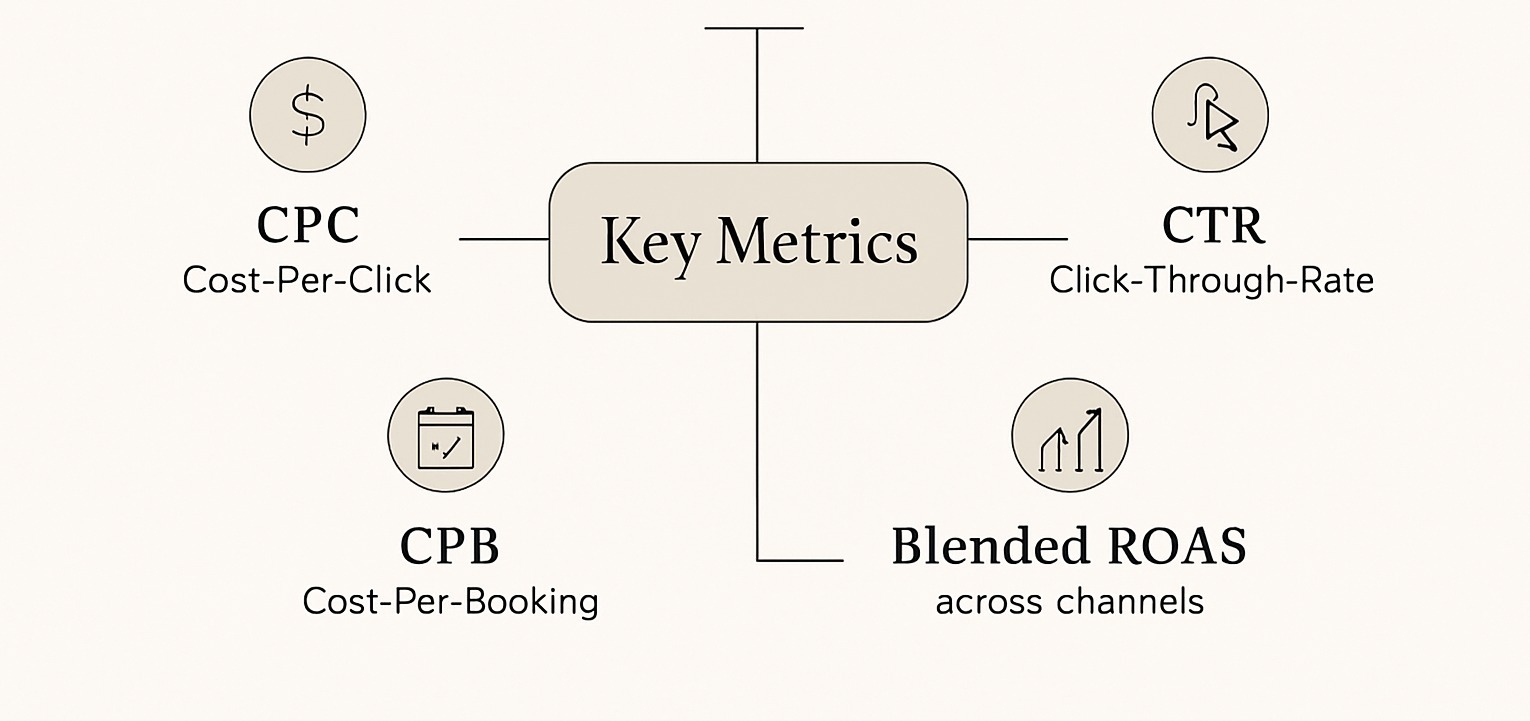
Key Metrics: Monitor CPC (cost-per-click), CTR (click-through-rate), CPB (cost-per-booking), and blended ROAS across channels.
-
Avoid Common Mistakes: Don’t just focus on short-term ROAS. Ignoring seasonality or failing to track repeat bookings can mislead your strategy.
Beyond ROAS: Understanding True Profitability
ROAS is important, but it’s not the whole story. Think bigger:
-
Lifetime Value: A guest who books once may return, or bring friends and family. Measuring only immediate ROAS undervalues these long-term bookings.
-
Blended Metrics: Combine ROAS with Cost Per Booking (CPB) and overall revenue to get a full picture.
-
Benchmark Smartly: Compare against industry averages and your hotel type to set realistic goals, not arbitrary targets.
Test, Optimize, & Connect
ROAS might sound like a dry metric, but for hoteliers, it’s pure gold. It tells you what’s working, what’s not, and where to put your marketing dollars for maximum impact. The average Google Ads ROAS for hotels is a helpful benchmark, but real success comes from testing, optimizing, and connecting your campaigns with your guests’ journey.
So next time you log into Google Ads, don’t just stare at impressions, look at ROAS. Adjust your campaigns, refine your targeting, and watch those direct bookings climb.
Your ads are essentially guests walking through your doors. Make every dollar count.