


This article was created by Gourmet Marketing, a restaurant marketing agency focused on strategy, digital marketing, and long-term growth for restaurants.
How Restaurants Can Prevent Bad Reviews and Win Back Guests When Things Go Wrong
Most restaurant owners wake up every day trying to do the same thing. Serve great food, treat people well, and keep the business moving forward. Yet even with the best intentions, mistakes still happen. A ticket gets lost. A table waits too long. A dish comes out wrong. And sometimes, that moment becomes a one-star review that lives on the internet forever.
The truth is this. You cannot prevent every mistake. But you can absolutely control how often they happen and how you respond when they do. A survey found that 50% of locals stated that a negative review made them question the business (Forbes). The restaurants that survive bad reviews are not the ones that never mess up. They are the ones who know how to recover.
“Restaurant owners put their whole lives into this work. A bad review can feel personal, but it is rarely the full story. What matters is what you learn from it. If you fix the root problem and close the loop with the guest, that one negative moment becomes part of how you build a stronger business.”
— Onur Kiyak, CEO at Gourmet Marketing
Let us walk through what actually works.
The One Meal That Defines You
Guests might enjoy your music, your décor, and your service. But at the end of the day, your reputation rests on the plate you put in front of them.
One bad dish has more impact than three good visits (Restroworks). That is just how people remember experiences. Most guests will not rush online to praise something that was fine. But a soggy pasta, cold steak, or bland sauce will absolutely get written about.
This is why menu confidence matters so much.
A crowded menu often looks impressive on paper, but it creates risk in real life. More items mean more prep, more room for inconsistency, and more pressure on the kitchen during rushes. The smarter play is to design a menu around what your team can execute beautifully every night, even on your worst staffing day.
Ask yourself a hard question about every dish. If your best cook called in sick tonight, would you still feel proud serving it?
If the answer is no, it does not belong on your menu.
Strong kitchens revisit this constantly. They taste food together. They cut weak performers. They do not protect dishes based on nostalgia or ego. They protect only what works on the line.
Service Is Where Small Problems Become Big Problems
Most bad reviews are not really about food or service alone. They are about how the guest felt while the problem was happening.
Thirty minutes without a greeting. The wrong dish delivered with no apology. A server avoiding the table instead of fixing the issue. These moments turn a simple mistake into a personal insult for the guest.
This is where systems save you.
Training cannot live in your head. It has to live in writing. How guests are greeted. How orders are confirmed. How problems are escalated. How managers step in. Every role should know exactly what to do when something feels off.
Culture matters here too, but culture only works when the rules are clear. You are not just hiring nice people. You are training professionals who know how to protect the guest experience even under pressure.
Consistency is the goal. Guests forgive mistakes. They do not forgive chaos.
What to Do Right in the Moment When Something Goes Wrong
This is where many restaurants lose the battle before the review is ever written.
If a dish is wrong, late, or cold, the worst thing a server can do is freeze or disappear. Silence feels like neglect to a guest.
Every staff member should be trained with a simple recovery script they can use without asking permission:
-
Acknowledge the issue immediately
-
Apologize without excuses
-
Offer a clear solution
-
Loop in a manager fast
For example:
"I am really sorry about that. We will remake this right now, and I am bringing you a fresh appetizer while you wait. I will also have my manager come say hello."
That one-minute exchange can save a five-thousand-word rant online.
Comping food when appropriate is not weakness. It is marketing. A ten-dollar loss today often prevents a hundred lost guests later.
The Review Is Not the Enemy. The Silence Is.
Even if you handle things perfectly in-house, reviews still happen. Some are fair. Some are emotional. Some are completely unhinged.
What matters is not the review itself. It is your response.
Future guests do not just read what the upset diner wrote. They read how you replied.
A strong response always follows the same flow:
-
Thank them for the feedback
-
Apologize sincerely
-
Acknowledge the issue
-
Offer a way to continue the conversation privately
Here is a simple version that works:
"Thank you for sharing this. I am truly sorry that your visit fell short of what we aim to deliver. That is not the experience we want for any guest. I would appreciate the chance to speak with you directly and make this right. Please reach out to me at our restaurant email."
No defensiveness. No excuses. No corporate fluff. Just ownership.
Avoid generic replies that look copied and pasted. Guests can spot those instantly. Speak like a human.
Also, do not wait weeks to respond. Speed shows that you care. Silence suggests that you do not.
How Negative Reviews Can Actually Help You
This may sound strange, but negative reviews often reveal the most useful information about your operation.
If multiple people mention long ticket times, that is a systems issue. If several guests complain about one dish, the problem is not the reviewer. It is the recipe. If staff attitude comes up repeatedly, that is a leadership conversation waiting to happen.
Strong operators use reviews as free consulting.
Even better, some of your best future marketing moments come from how you resolve a problem. Guests absolutely do update reviews when they feel heard. They also tell friends when a restaurant handled a bad situation with class.
Those stories carry far more weight than ads ever could.
A Simple Checklist You Can Use Immediately
For your kitchen
-
Cut dishes your team cannot execute consistently
-
Hold weekly tasting and feedback sessions
-
Simplify prep where possible
For your service team
-
Train clear steps for fixing mistakes
-
Empower staff to act fast, not freeze
-
Require managers to touch tables when issues arise
For your online presence
-
Monitor reviews daily
-
Respond within forty-eight hours
-
Keep replies human and accountable
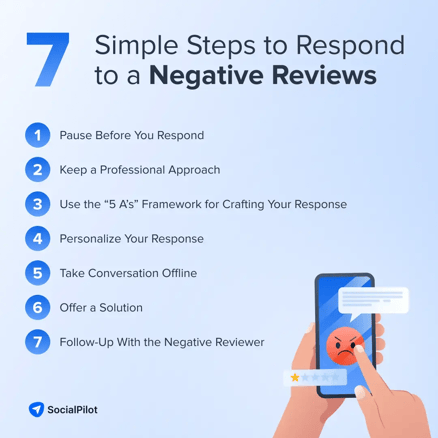 Source: SocialPilot
Handling
No restaurant is perfect. Mistakes will happen. Food will sometimes miss. People will have bad nights. That is the business.
What separates average restaurants from trusted ones is not the absence of problems. It is the presence of leadership when things go wrong.
If you protect your menu, train your staff with intention, and respond to guests with honesty and speed, your reputation becomes stronger, not weaker, with time.
And when a bad review shows up tomorrow morning, you will know exactly what to do.
Frequently Asked Questions
How fast should I respond to a bad review?
Ideally, within 24 to 48 hours. Fast responses show guests that you are paying attention and that feedback matters to you. Waiting too long often makes the situation feel ignored and gives the review more time to influence potential guests.
Should I respond to every review, even the unfair ones?
Yes. You do not need to debate every detail, but every review deserves a professional response. Future guests are watching how you handle criticism. A calm, respectful reply often does more for your reputation than proving a reviewer wrong.
Is it better to take review conversations offline?
Publicly acknowledge the issue, then move the resolution offline. This protects the guest’s privacy and gives you room to fix the problem properly. Always leave the door open by offering an email, phone call, or direct message.
When should I comp a meal or offer a refund?
Comp when the mistake clearly affects the guest experience in a meaningful way. Cold food, incorrect orders, long delays, or service breakdowns usually warrant compensation. It is not about giving things away. It is about protecting trust and preventing long-term revenue loss.
How do I handle a guest who is clearly just trying to get free food?
Stay polite and factual. Never accuse a guest publicly. Offer to discuss the issue privately and review what happened through your systems. Most guests looking for freebies lose interest once they realize there is a real process in place.
What is the biggest mistake restaurants make with bad reviews?
Getting defensive. Explaining too much. Blaming staff publicly. Guests respond far better to ownership, empathy, and a genuine attempt to make things right than to long explanations or excuses.
How can I stop the same complaints from showing up again and again?
Look for patterns, not one-off comments. If you see repeated issues around wait times, service attitude, or a specific menu item, that is a systems problem, not an individual problem. Fixing that root cause will naturally improve your reviews over time.
Can bad reviews actually help my restaurant grow?
Yes, if you use them properly. Reviews often point directly to the weak spots in your operation. Restaurants that improve fastest are usually the ones that listen the closest to uncomfortable feedback and act on it.